

“You are the biggest cricket star Bangladesh has ever produced. Even your critics acknowledge your contribution to the game. Yet today, it seems that seven months of politics have overshadowed everything you achieved on the field, and you are paying the price for it. How unexpected is that?”
For a few seconds, there was silence on the other end of the phone.
Then came the voice of Shakib Al Hasan: – “Not just unexpected—it’s unacceptable to me. But what more can I say about it? You’re talking about seven months of politics. Some people even say my current situation is because I didn’t post a single Facebook status. What a situation this is!”
Perhaps those four words—“What a situation”—capture the essence of Shakib Al Hasan’s entire life.
As the saying goes:
“People are not born heroes or villains; they are born people, and the world decides what to call them.”
Few lives embody that idea as perfectly as Shakib’s.
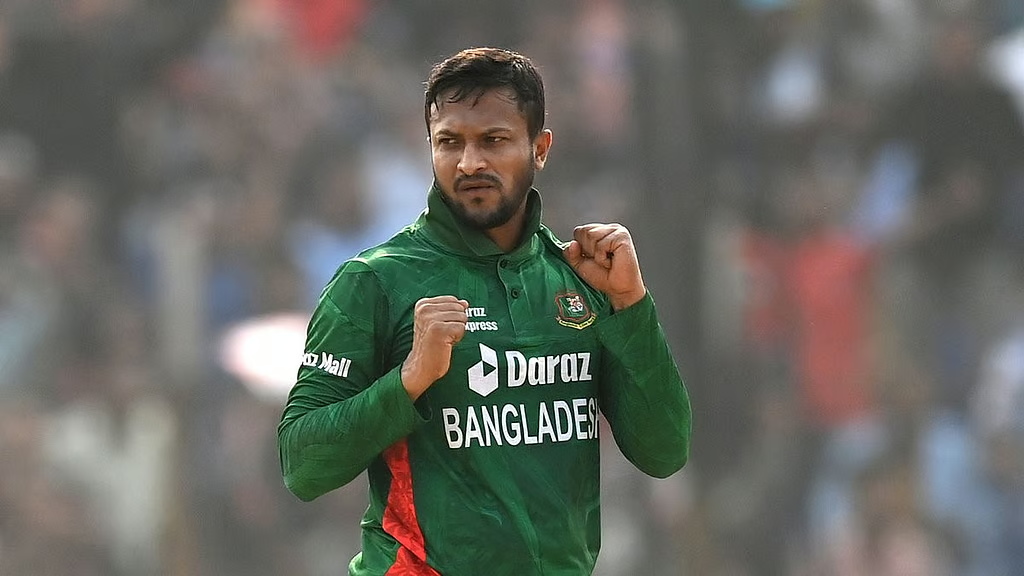
Once celebrated as a cricketing miracle, he has also been labeled arrogant, controversial, selfish, rebellious, and, by many, the greatest cricketer in Bangladesh’s history. He has been both hero and villain, often at the same time. And that is precisely what makes his story unique.
There has never been another talent quite like him in Bangladeshi cricket. The sport has produced countless all-rounders, but very few have dominated all three formats of the game with the consistency required to become the world’s number-one all-rounder. Shakib was one of those rare exceptions. A player capable of being his team’s best batter, best bowler, and coolest head in the same match.
He once said:
“By Bangladesh’s standards, I’ve achieved many things before their time.”
To some, that sounded like arrogance.
In reality, Shakib was among the first Bangladeshi cricketers to normalize ideas such as franchise cricket, personal branding, and professional independence. Concepts that are commonplace today once earned him accusations of being unpatriotic.
From Faisal of Magura to Shakib Al Hasan
The story of Shakib Al Hasan is almost cinematic.
Born on March 23, 1987, in Magura, he was obsessed with sports from childhood. His talent stood out so dramatically that local teams often hired him to play in village tournaments. During one such match, an impressed umpire arranged for him to train at Islampur Para Club in Magura. There, bowling with a proper cricket ball for the first time in his life, Shakib took a wicket with his very first delivery.
The tape-tennis boy quickly began showcasing his abilities with both bat and ball.
A brief period of training at BKSP, opportunities with Khulna Division, and an early call-up to Bangladesh’s Under-19 team soon followed. In the 2005 Under-19 Tri-Nation Tournament final, he scored a century off just 86 balls and took three wickets, announcing himself as a future star of Bangladeshi cricket.
French novelist Victor Hugo once wrote:
“Nothing is more powerful than an idea whose time has come.”
Shakib’s time had arrived.
Although his formal training at BKSP lasted only six months, it sharpened the extraordinary talent already within him. He made an immediate impact at every level. His Under-17 debut produced three wickets. In 2005, he scored 82 against England Under-19s and followed it with a century and three wickets in the tournament final. Across 18 Youth ODIs, he accumulated 563 runs and 22 wickets. At just 17, he made his first-class debut for Khulna and later claimed five wickets against Zimbabwe A in 2005.
Looking back at those early years, one is reminded of T.S. Eliot’s famous words:
“Home is where one starts from.”
Shakib’s domestic foundation was built so solidly that conquering the world seemed only a matter of time.
A Global Cricketing Nomad
Shakib Al Hasan became one of cricket’s great globetrotters.
Despite occasionally missing tournaments due to No Objection Certificate (NOC) complications, he remained a sought-after player across franchise leagues. In the 2023 Lanka Premier League, representing Galle Marvels, he scored 30 runs off 21 balls and claimed two wickets in a vintage all-round performance.
After returning from his ICC suspension, he created history during the 2020 Bangabandhu T20 Cup, becoming only the third cricketer in the world to complete the remarkable double of 5,000 T20 runs and 300 wickets.
He continued to deliver match-winning performances in domestic competitions, including the 2022 Swadhinata Cup.
Controversies, criticism, and off-field storms never seemed capable of suppressing the cricketer within him. Like the mythical Phoenix, Shakib repeatedly rose from the ashes, proving that reinvention was one of his greatest gifts.
Beyond the Boundary
Shakib never confined himself to the 22-yard pitch.
After obtaining a U.S. Green Card in 2018, his life became increasingly global. He served as a UNICEF Goodwill Ambassador, worked with anti-corruption campaigns, and collaborated with international brands such as Huawei. He ventured into business as Chairman of Monarch Holdings and later entered the gold trading sector through Burak Commodities.
Yet the bouncers he faced outside cricket proved far more difficult to handle than those he encountered on the field.
The Biggest Gamble: Politics
Perhaps the greatest gamble of Shakib’s life was politics.
In Bangladesh’s 2024 general election, he was elected as a Member of Parliament from Magura-1 under the Awami League banner. But fate had other plans. Only seven months later, the mass uprising of August led to the dissolution of Parliament, bringing his political career to an abrupt halt. Later, when BNP candidate Munawar Hossain Khan won the constituency in the 2026 election, the curtain effectively fell on Shakib’s political chapter.
George Bernard Shaw once wrote:
“Politics is the last refuge of the scoundrel.”
Whether or not that applies here, Shakib undoubtedly encountered the harsh realities of political life.
Reflecting on Bangladesh’s changing political landscape, he remarked:
“There was a time when it seemed everyone supported the Awami League. Now it seems nobody does. That’s the situation.”
When asked why he entered politics during his playing career, the confident and often combative cricketer suddenly sounded like the humble boy from Magura.
“I was never Shakib Al Hasan in Magura. I was always Faisal.”
Despite fierce criticism, he remains unapologetic about his decision.
“I don’t think I did anything wrong.”
Exile, Allegations, and Uncertainty
Following the political transition, Shakib found himself facing a series of legal and financial challenges.
The Anti-Corruption Commission seized documents connected to investigations involving allegations of stock-market manipulation worth billions of taka. The accusations claim that ordinary investors were misled in schemes involving enormous financial gains. As investigations continue, Shakib’s life is now largely based in the United States, far from the country where he became a national icon.
There was a time when thousands packed Mirpur Stadium for a glimpse of him.
Today, simply returning to Bangladesh appears to be his greatest challenge.
Asked whether he would first visit Magura or Mirpur if he returned home, his response carried unmistakable sadness:
“Right now, my biggest concern is simply being able to set foot in Dhaka.”
The Tragedy of a Hero
Bangladesh cricket has changed dramatically. Former teammate and longtime friend Tamim Iqbal now leads the country’s cricket administration, and Shakib has expressed optimism that future leadership will have time to make thoughtful decisions for the game’s development.
Yet beyond cricket administration and political upheaval lies a larger story.
American novelist F. Scott Fitzgerald once wrote:
“Show me a hero, and I’ll write you a tragedy.”
Few modern Bangladeshi lives fit that description better than Shakib Al Hasan’s.
He remains simultaneously a hero and a villain, a champion and a controversy, a sporting legend and a political cautionary tale. For millions of Bangladeshis, he will forever be the greatest cricketer the country has ever produced. For others, he is proof that greatness alone cannot shield a person from the consequences of their choices.
And perhaps that is the enduring mystery of Shakib Al Hasan: a man whose achievements made him immortal, yet whose life continues to divide the nation he once united.