Artificial Intelligence in Education: a Tool, Not a Replacement
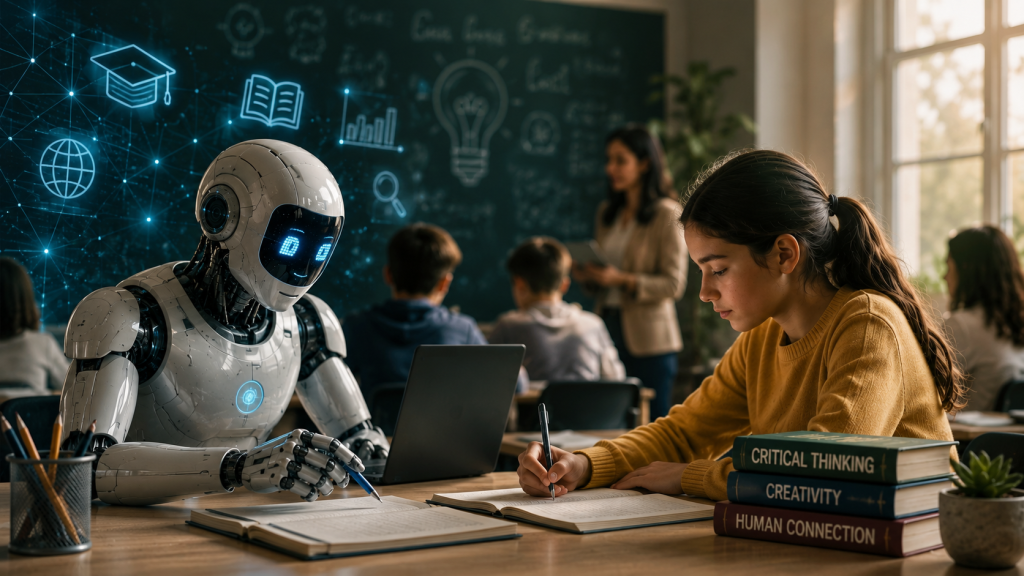
Artificial Intelligence (AI) is the simulation of human intelligence processed by machines, particularly computer systems. AI refers to the ability of machines (software or hardware) to perform tasks that typically require human intelligence, such as learning, reasoning, perception, problem-solving, and creativity. The rapid advancement of AI is transforming nearly every sector, and education is no exception. From personalized tutoring systems to automated grading and intelligent content recommendations, AI promises to make learning more effective, accessible, and efficient. However, as schools, universities, and edtech companies rush to integrate these tools, a critical principle must guide their adoption: AI should be a powerful tool to enhance teaching and learning, not a replacement for human educators or irreplaceable human elements of education. AI is one of the powerful drivers that brought a revolutionary change in education by offering transformative opportunities for the education system. It improves the effectiveness and ensures quality. It gives the teaching and learning services at a minimal amount of cost or cost-free. In most countries, some educational resources, such as AI text generators, AI tools, etc., are commonly used by the teachers and students in the classroom. As the AI (GenAI) tools are generally available and outgoing, the govt. is failing to create rules for them. This leaves our private data unprotected and schools unprepared to safely check or use these tools. This humanistic guidance calls for AI regulations like strong data privacy protection and age limits for kids’ independent AI chats while promoting human-centered, age-appropriate ethical use in education and research. We can have personalized learning, instant feedback, 24/7 learning assistance, translations, data analysis, etc. benefits from AI. Treating AI as a substitute risks undermining the relational, creative, and ethical dimensions that define good education. Though AI can answer within seconds, it cannot be replaced with teachers. Teachers can understand emotions, give motivations, build confidence, encourage and guide teamwork, and teach ethics and values, which AI can’t. We have to remember that a teacher is a human being, so he can understand a student well, but AI is nothing but a generated computer. So, it lacks empathy and real-life experience. For years, AI quietly helped with grading and tests in schools, but most people didn’t notice. Then generative AI suddenly arrived on students’ and teachers’ devices, which has changed everything. These AI-generated tools can write essays, solve problems, and do tasks for us. They weren’t meant for learning. This sparked big worries about cheating and grades, such as students making fake results, admitting cards, and cheating in exams. Also, students are not using their brains. Rather, they are getting completely dependent on AI. Sometimes, AI can make mistakes, but students are using the information blindly without judging it. Also, their critical thinking capacity is getting reduced day by day. As AI is transforming education by making learning more individualized, effective, and accessible, we can use it as a guideline, not a replacement. We also have to verify the facts using reliable sources. Teachers also should integrate AI lessons responsibly. Education is fundamentally a human process based on communication, empathy, creativity, and mentorship. The future of education lies not in replacing teachers with artificial intelligence, but in empowering teachers and students to use AI responsibly as a tool for better learning.