
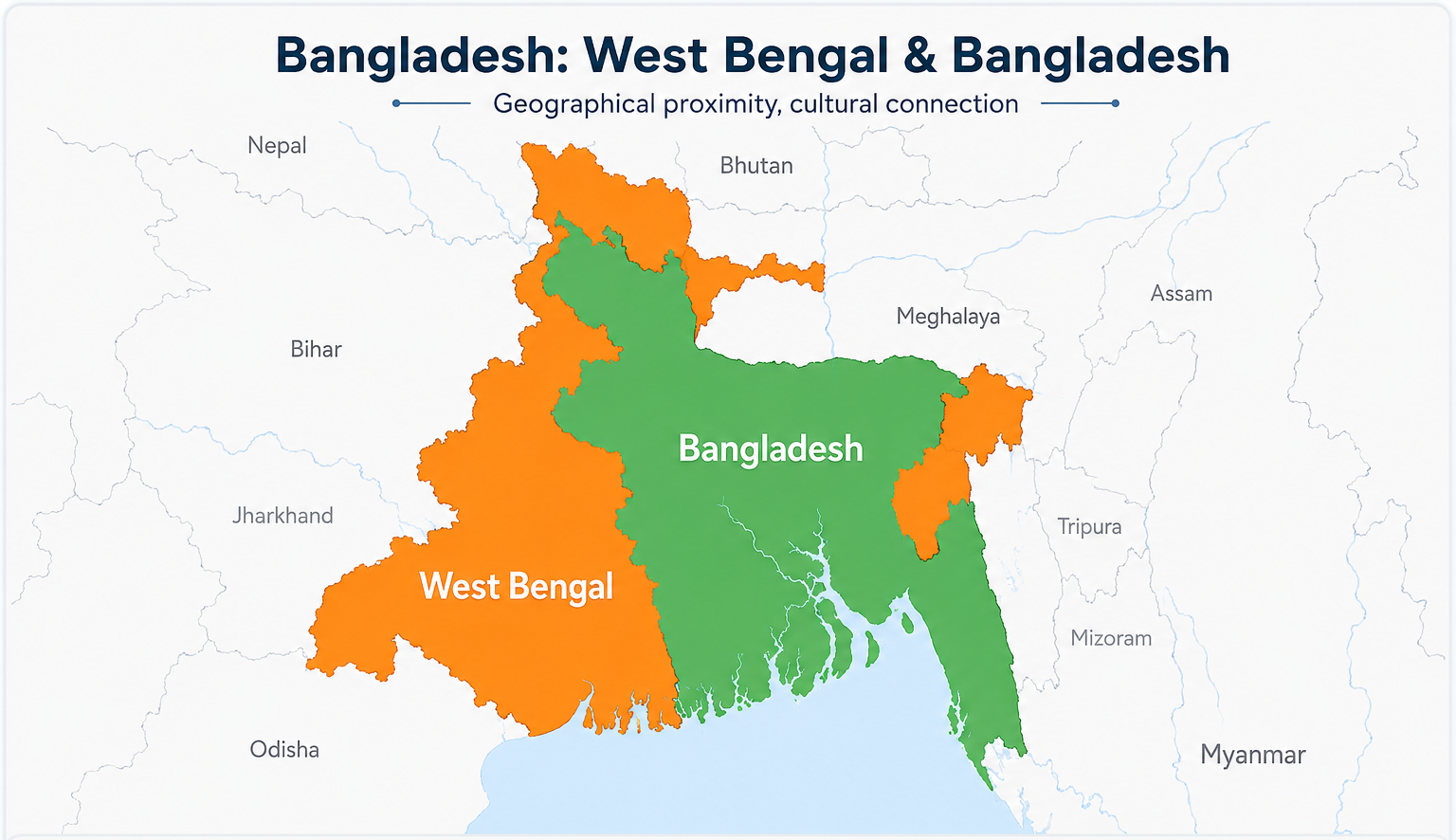
Nearly 80 years after the Partition of 1947, that old word from history seems to be returning in a new form. However, this time it is not through refugee-packed trains, barbed-wire borders, or bloody separation, but through Facebook posts, viral videos, political slogans, and heated social debates surrounding Eid-ul-Adha.
Recently, the West Bengal government issued strict guidelines regarding animal slaughter and Qurbani (Eid sacrifice), which the Calcutta High Court also upheld. According to the new rules, animal slaughter without administrative permission, open public sacrifice, and slaughter activities without proper certification are prohibited. The government claims that these measures are intended to ensure law and order, public health, and environmental protection. However, critics argue that although administrative permission is mentioned, obtaining it in practice has become difficult in many areas, or delays in the approval process make it impossible to complete procedures on time. As a result, uncertainty and confusion have emerged regarding religious practices, further increasing public dissatisfaction.
The situation became so sensitive that even the Imam of Kolkata’s historic Nakhoda Mosque urged Muslims to refrain from sacrificing cattle. This statement further intensified the debate on social media. A wave of posts, videos, and live discussions quickly spread anger, frustration, religious sentiment, and political arguments.
A major factor fueling this controversy is the algorithm-driven nature of social media platforms. On Facebook, YouTube, X (Twitter), and Reddit, numerous pages and political accounts interpret events in line with their own ideologies. Short video clips, interviews of distressed farmers, confrontations with police, and even old footage are often circulated with new claims, spreading rapidly within minutes. As a result, real events, exaggerations, and misinformation blend, creating a highly charged digital environment.
However, this crisis is not purely religious; it is also deeply connected to economic and political factors. Many farmers and traders in the cattle markets have suffered financial losses due to reduced sales during the Eid season. Not only Muslims but also many Hindu cattle farmers have reportedly been affected economically. Traders claim that reduced cattle supply from border areas, transportation difficulties, and increased administrative monitoring have also impacted the market. Consequently, the issue has gradually shifted from a religious debate to a broader discussion on social and economic instability.
According to political analysts, religious polarization in West Bengal has intensified since the rise of the Bharatiya Janata Party. On one side is the expansion of Hindu nationalist politics, while on the other is a counter-political stance centered around the Muslim vote bank. In this conflict, even the religious sentiments of ordinary people are increasingly being used as political tools.
Various social media posts claim that Muslims are facing growing social and administrative pressure. On the other hand, hardline Hindu nationalist groups use terms like “West Bengal” to mock the Muslim population and political landscape of West Bengal. Some also use the term “Muslim Bengal” as a symbol of demographic change and cultural transformation. Thus, the same words carry completely different meanings for different groups.
This debate is not limited to West Bengal alone—it has also triggered strong reactions across the broader Bengali-speaking online community, including Bangladesh. Users from both sides interpret the issue from different perspectives: some view it as an example of religious rights being restricted, while others see it as a matter of law enforcement and social regulation.
Interestingly, both sides are now using the term “Partition” in their own ways. One side argues that Muslim rights are being restricted, while the other claims that the identity of West Bengal is changing. In other words, the same word that once physically divided people in 1947 is now, in 2026, dividing them mentally, culturally, and politically.
However, the reality is that not all information circulating on social media is true. Several videos, images, and claims have already been proven misleading or false. Old footage from past riots has been circulated as recent events, videos from other countries have been presented as if they were from West Bengal, and edited clips have been used to create emotional tension. Yet in the politics of emotion, feelings often spread faster than facts. For this reason, “Partition” is no longer just a chapter of history; it has once again become a political symbol, a social anxiety, and a slogan in a new age of online conflict.