How Royal Challengers Bengaluru Transformed from IPL’s Biggest Meme to a Championship Dynasty
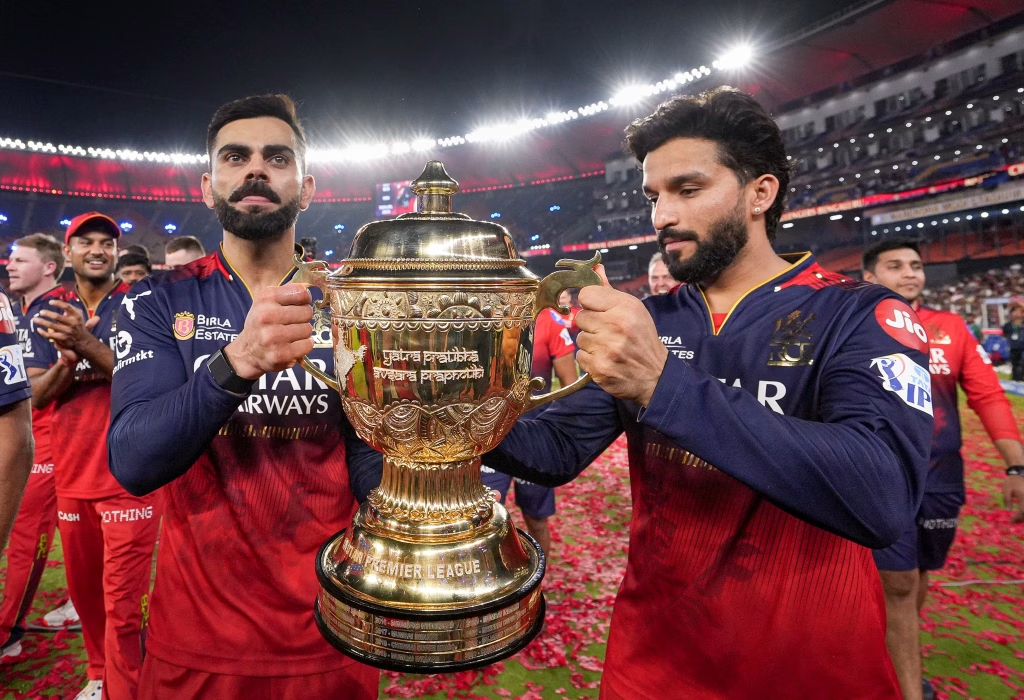
For nearly two decades, supporting Royal Challengers Bengaluru (RCB) was never merely about cricket. It was an emotional commitment, a journey defined by hope, heartbreak, and unwavering loyalty. Every IPL season began with dreams. Every season seemed to end with disappointment. Yet millions of supporters continued to believe. Through final defeats, dramatic collapses, relentless trolling, and countless memes, one slogan remained alive in the hearts of fans: “Ee Sala Cup Namde” — This year, the cup is ours. For seventeen long seasons, it wasn’t. Then, history changed. In 2025, Royal Challengers Bengaluru finally achieved what generations of supporters had been waiting for. By defeating the Punjab Kings in the IPL final, they lifted their maiden trophy and ended one of the longest title droughts in franchise cricket. Many believed that victory was the perfect conclusion to a story filled with suffering and perseverance. Instead, it became the beginning of a new chapter. Just a year later, RCB successfully defended their title, defeating Gujarat Titans in the 2026 IPL Final and establishing themselves as one of the league’s elite franchises. The team that had once been cricket’s most famous underachiever had transformed into a champion dynasty. The Long Road to Glory When the IPL was launched in 2008, RCB immediately became one of its most glamorous franchises. Backed by Vijay Mallya and featuring icons such as Rahul Dravid, Anil Kumble, Jacques Kallis, and Mark Boucher, expectations were enormous. However, the inaugural season exposed a fundamental problem. While other teams adapted quickly to the fast-paced nature of T20 cricket, RCB struggled with a more traditional approach and finished seventh out of eight teams. Yet the disappointing start did little to weaken the bond between the franchise and the city of Bengaluru. The fanbase continued to grow, laying the foundation for one of cricket’s most loyal supporter cultures. Years of Near Misses The heartbreak truly began in 2009 when Anil Kumble led RCB to their first IPL final. Despite a brilliant bowling performance from the legendary captain, the team fell agonizingly short against the Deccan Chargers. More disappointment followed in 2011. Powered by the explosive arrival of Chris Gayle and the emergence of Virat Kohli, RCB reached another final only to be outclassed by Chennai Super Kings. The years that followed produced some of the most entertaining cricket ever witnessed in the IPL. Gayle’s six-hitting heroics, AB de Villiers’ extraordinary innovation, and Kohli’s relentless consistency turned RCB into a global phenomenon. Yet trophies remained elusive. The Pain of 2016 For many supporters, no season was more painful than 2016. Virat Kohli delivered arguably the greatest individual campaign in IPL history, scoring 973 runs and smashing four centuries. Alongside AB de Villiers, he carried RCB into the final against Sunrisers Hyderabad. Everything appeared perfectly scripted. Playing at home in Bengaluru, chasing a challenging target, with Kohli in the form of his life, RCB seemed destined to create history. Instead, they suffered another heartbreaking defeat. For fans, it felt like the cruelest chapter of all. From Mockery to Mastery The years between 2017 and 2019 marked the franchise’s darkest period. The infamous 49 all-out against the Kolkata Knight Riders became a symbol of RCB’s struggles. Social media mockery intensified, and “Ee Sala Cup Namde” became one of cricket’s most ridiculed slogans. However, beneath the criticism, the franchise began to learn valuable lessons. RCB gradually shifted away from relying solely on superstar names and focused on building a balanced squad. Better recruitment, improved bowling resources, stronger domestic talent development, and a clearer strategic vision began to reshape the organization. The Championship Era The breakthrough finally arrived in 2025. This RCB team looked different. More mature. More balanced. More composed. In a tense final against the Punjab Kings, they held their nerve and secured a memorable victory, bringing an 18-year wait to an end. For Virat Kohli, who had devoted the prime years of his career to the franchise, it was a deeply emotional moment. One year later, RCB proved their success was no accident. By successfully defending the IPL title in 2026, they silenced the remaining doubters and completed one of the greatest redemption stories in sports history. Virat Kohli: The Heart of the Journey No figure embodies the RCB story more than Virat Kohli. He experienced every setback, every criticism, every final defeat, and every failed campaign. Yet he remained loyal to the franchise throughout. When RCB finally lifted the trophy in 2025, it was more than a championship victory. It was the completion of a journey nearly two decades in the making. The successful title defense in 2026 elevated that journey into legend. More Than a Cricket Story RCB’s transformation is about far more than winning trophies. It is a story of resilience in the face of failure. It is a story of supporters who never stopped believing. It is a story of a franchise that endured years of disappointment before finally reaching the summit. From heartbreak to history, from memes to medals, from underachievers to champions, Royal Challengers Bengaluru have authored one of the greatest redemption arcs in IPL history. And for millions of fans who waited nearly two decades to witness it, the slogan that once represented hope has finally become reality. “Ee Sala Cup Namde.”
One Word, Two Narratives: How ‘Partition’ Became Bengal’s New Political Weapon
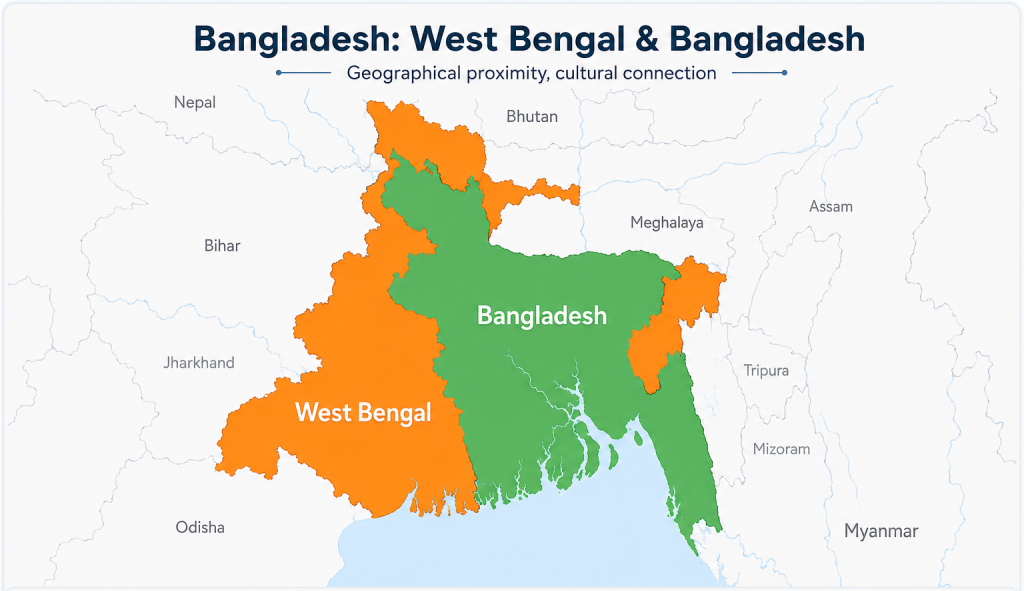
Nearly 80 years after the Partition of 1947, that old word from history seems to be returning in a new form. However, this time it is not through refugee-packed trains, barbed-wire borders, or bloody separation, but through Facebook posts, viral videos, political slogans, and heated social debates surrounding Eid-ul-Adha. Recently, the West Bengal government issued strict guidelines regarding animal slaughter and Qurbani (Eid sacrifice), which the Calcutta High Court also upheld. According to the new rules, animal slaughter without administrative permission, open public sacrifice, and slaughter activities without proper certification are prohibited. The government claims that these measures are intended to ensure law and order, public health, and environmental protection. However, critics argue that although administrative permission is mentioned, obtaining it in practice has become difficult in many areas, or delays in the approval process make it impossible to complete procedures on time. As a result, uncertainty and confusion have emerged regarding religious practices, further increasing public dissatisfaction. The situation became so sensitive that even the Imam of Kolkata’s historic Nakhoda Mosque urged Muslims to refrain from sacrificing cattle. This statement further intensified the debate on social media. A wave of posts, videos, and live discussions quickly spread anger, frustration, religious sentiment, and political arguments. A major factor fueling this controversy is the algorithm-driven nature of social media platforms. On Facebook, YouTube, X (Twitter), and Reddit, numerous pages and political accounts interpret events in line with their own ideologies. Short video clips, interviews of distressed farmers, confrontations with police, and even old footage are often circulated with new claims, spreading rapidly within minutes. As a result, real events, exaggerations, and misinformation blend, creating a highly charged digital environment. However, this crisis is not purely religious; it is also deeply connected to economic and political factors. Many farmers and traders in the cattle markets have suffered financial losses due to reduced sales during the Eid season. Not only Muslims but also many Hindu cattle farmers have reportedly been affected economically. Traders claim that reduced cattle supply from border areas, transportation difficulties, and increased administrative monitoring have also impacted the market. Consequently, the issue has gradually shifted from a religious debate to a broader discussion on social and economic instability. According to political analysts, religious polarization in West Bengal has intensified since the rise of the Bharatiya Janata Party. On one side is the expansion of Hindu nationalist politics, while on the other is a counter-political stance centered around the Muslim vote bank. In this conflict, even the religious sentiments of ordinary people are increasingly being used as political tools. Various social media posts claim that Muslims are facing growing social and administrative pressure. On the other hand, hardline Hindu nationalist groups use terms like “West Bengal” to mock the Muslim population and political landscape of West Bengal. Some also use the term “Muslim Bengal” as a symbol of demographic change and cultural transformation. Thus, the same words carry completely different meanings for different groups. This debate is not limited to West Bengal alone—it has also triggered strong reactions across the broader Bengali-speaking online community, including Bangladesh. Users from both sides interpret the issue from different perspectives: some view it as an example of religious rights being restricted, while others see it as a matter of law enforcement and social regulation. Interestingly, both sides are now using the term “Partition” in their own ways. One side argues that Muslim rights are being restricted, while the other claims that the identity of West Bengal is changing. In other words, the same word that once physically divided people in 1947 is now, in 2026, dividing them mentally, culturally, and politically. However, the reality is that not all information circulating on social media is true. Several videos, images, and claims have already been proven misleading or false. Old footage from past riots has been circulated as recent events, videos from other countries have been presented as if they were from West Bengal, and edited clips have been used to create emotional tension. Yet in the politics of emotion, feelings often spread faster than facts. For this reason, “Partition” is no longer just a chapter of history; it has once again become a political symbol, a social anxiety, and a slogan in a new age of online conflict.