

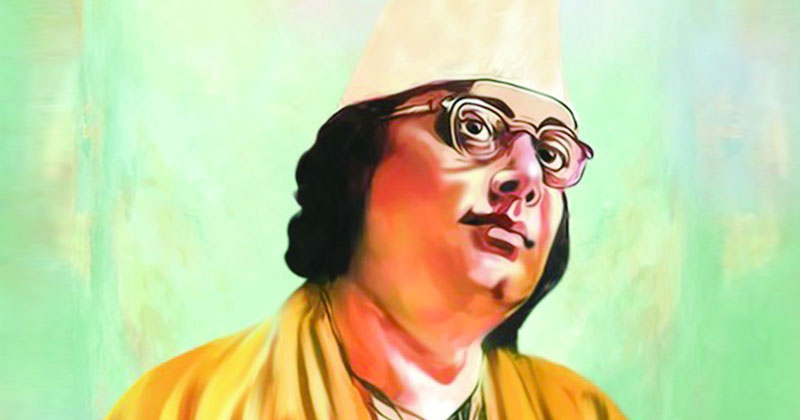
When the Kolkata police arrived to search Kazi Nazrul Islam’s house for banned books like Bisher Banshi, Bhangar Gaan, and Proloy Shikha, the poet did not resist. The officers turned the house upside down, scattering belongings everywhere, yet Nazrul remained calm and indifferent.
But suddenly, the police noticed a small box in a corner. As they moved toward it, the rebel poet became frantic. He pleaded with the lead officer, “Do whatever you want, but please do not touch this box.”
Ignoring his request, the police opened it. Inside were neatly arranged tiny clothes and toys belonging to Nazrul’s beloved son, Bulbul, who had passed away years earlier. The embarrassed officers saw tears shimmering in the poet’s eyes.
Though celebrated in Bengali literature as the “Rebel Poet,” this deeply emotional side of Nazrul was revealed through the memories and interviews of his son, Kazi Sabyasachi.
Nazrul adored his children and constantly worried about them. When little Bulbul died of smallpox at just four years old, the grief shattered him. Sabyasachi once said about his father, “I do not know how many people were blessed with such a generous-hearted father. In that sense, my brother and I were truly fortunate.”
Sabyasachi’s nickname was “Sani,” inspired by Chinese revolutionary leader Sun Yat-sen, whom Nazrul admired deeply. His younger brother, Kazi Aniruddha, was lovingly called “Nini,” after Vladimir Lenin. Nazrul had four sons in total. His first son, Krishna Muhammad, died in infancy, while Bulbul passed away at the age of four.
‘তোমার সানি যুদ্ধে যাবে
মুখটি করে চাঁদ পানা
কোল ন্যাওটা তোমার নিনি
বোমার ভয়ে আধখানা…’
He also made up another playful rhyme for the two brothers:
‘সানি নিনি দুই ভাই
ব্যাং মারে ঠুইঠাই।’
Whenever Nazrul traveled away from home, he regularly wrote letters to his sons. Every letter ended with the same affectionate line:
“Take my kisses.
Yours, Baba.”
Before falling seriously ill, Nazrul once dreamed of building a home in Baguiati, Kolkata. He even paid an advance for several bighas of land there. He would often take his family to visit the site and excitedly describe his plans: a bungalow-style house with a pond in the middle, fish in the water, and rooms arranged carefully for the family. He especially worried about little Nini going too close to the pond because the boy could not swim.
But the dream never materialized. One day, while inspecting the land, Nazrul was disturbed by the foul smell of garbage carts passing nearby. Covering his nose with a handkerchief and applying perfume for himself and his sons, he firmly declared, “No, we will not build a house here. I won’t be able to write in this stench. My boys will fall sick.”
Nazrul also loved taking his sons to football matches, theaters, and cinemas. Once, during an IFA Shield match between Mohammedan Sporting and K.C.B., he suddenly realized Sani and Nini were missing in the crowd. Panic-stricken, he began shouting, “Where is Sani? Where is Nini?” The entire stadium stared in shock until the boys were finally found and safely brought home in a taxi.
Yet Nazrul’s affection was balanced with discipline. One afternoon, while the adults were busy playing cards, young Sabyasachi and Aniruddha decided to experiment with matches. Soon, they accidentally set a sofa on fire, and within moments the room was engulfed in flames. When Nazrul discovered what had happened, he glared at the boys with such fierce anger that both brothers trembled in fear.