A Critical Overview of Capitalism in Karl Marx’s Das Kapital

Karl Marx’s Das Kapital is one of the most important books about capitalism and economic society. In this work, Marx tries to explain how capitalism actually functions beneath its surface appearance. He argues that capitalism may look fair because workers receive wages and goods are exchanged through markets, but the system is built on an unequal relationship between workers and capitalists. Marx begins with the idea of commodities. A commodity is something produced to be sold in the market. Every commodity has a use value, meaning its practical usefulness, and an exchange value, meaning what it can be traded or sold for. Marx believes that the value of a commodity is closely connected to the labor used to produce it. Human labor, therefore, becomes central to understanding capitalism. The most important relationship in capitalism is between the worker and the capitalist. Workers usually do not own land, factories, machines, or other means of production. Because of this, they must sell their labor power in order to survive. Capitalists buy this labor power by paying wages. However, Marx argues that workers create more value through their labor than they receive in wages. The extra value produced by workers is called surplus value, and this surplus becomes the source of profit for the capitalist. This is where Marx sees exploitation. The worker is paid, so the system appears legal and fair. But in reality, the capitalist gains wealth from the unpaid portion of the worker’s labor. For Marx, this hidden exploitation is the foundation of capitalist profit. Marx also discusses how capitalism affects human life. Workers can become alienated from their work because they do not own what they produce. The product belongs to the capitalist, not to the worker. As a result, work becomes less creative and meaningful and more like a forced activity done only for survival. Another major idea in Das Kapital is accumulation. Capitalists are always pressured to make more profit, expand production, reduce costs, and compete with others. This can lead to technological progress and economic growth, but it also creates inequality, unemployment, and economic crises. Marx believed that capitalism contains internal contradictions because it depends on workers while also exploiting them. Overall, Das Kapital is a critical analysis of capitalism. Marx’s main argument is that capitalism creates wealth, but that wealth is produced by workers and controlled by capitalists. The book challenges readers to look beyond the surface of markets and wages and understand the power relations hidden inside the economic system.
Searching for Truth in the Flood of Information: Why Epistemology Matters More Than Ever

Rapid developments in information technology have made human life easier, but they have also created new challenges. Every day, we are exposed to vast amounts of news, opinions, videos, social media posts, and AI-generated content. In this overwhelming flow of information, it is becoming increasingly difficult to determine what is true, what is misleading, and what is completely false. In this context, an important branch of philosophy—epistemology has gained renewed attention. Epistemology is the study of knowledge and the questions surrounding it. It explores what knowledge is, how humans acquire it, what counts as justified belief, and where the limits of knowledge lie. In simple terms, epistemology explains how we know something is true and how reliable that knowledge is. Once mainly confined to philosophical and academic discussions, epistemology is now closely connected to everyday life. Whether we are viewing information on social media, reading news, or receiving answers from AI systems, we consciously or unconsciously evaluate the truthfulness of that information. This process of evaluation is deeply rooted in epistemological thinking. How is Knowledge Formed? Human beings acquire knowledge from multiple sources: personal experience, observation, reasoning, memory, and information from others. However, believing something and knowing something are not the same. According to philosophers, for a belief to qualify as knowledge, it must be true, justified, and supported by evidence. Simply believing something is not enough; it must be backed by sufficient grounds. This distinction is especially important in the digital age, where misinformation can spread as quickly as accurate information. Difference Between Belief and Knowledge People often believe many things without adequate evidence. Popularity, repetition, or alignment with personal views does not necessarily make something true. Epistemology clarifies this distinction. It shows that while belief can be personal, knowledge must be verifiable. Therefore, before accepting any information, it is essential to examine its sources, evidence, and logical foundation. This is particularly crucial in the context of social media, where misinformation spreads rapidly. The Importance of Skepticism and Critical Thinking A key concept in epistemology is skepticism. Skepticism does not mean rejecting everything; rather, it means verifying claims before accepting them. When we encounter information, we should ask basic questions: What is the source? What evidence supports it? How was it obtained? Such questions form the foundation of critical thinking. This approach is essential in fields such as journalism, science, law, and research, where credibility depends on accuracy and evidence. Artificial Intelligence and the New Epistemological Reality The rapid advancement of artificial intelligence has added a new dimension to epistemology. AI systems can answer questions, write articles, and analyze complex data. However, there is no guarantee that all AI-generated information is accurate. At times, AI may present incorrect information confidently. Therefore, users must not only consume information but also verify its truthfulness. This necessity has further increased the importance of epistemological awareness. Impact on Education Modern education systems increasingly emphasize critical thinking, media literacy, and research-based learning. These skills are grounded in epistemological principles. Students are taught how to verify information, choose reliable sources, and identify logical errors. As a result, they move beyond memorization toward analysis and evaluation of knowledge. Is Knowledge Absolute and Unchanging? Another important lesson of epistemology is that human knowledge is always evolving. Memory can be flawed, perception can be misleading, and new evidence can change established ideas. History of science provides many examples where theories once considered absolute truths were later revised or replaced based on new evidence. Thus, knowledge is not static but a continuously evolving process. For this reason, epistemology is not merely a theoretical branch of philosophy. It is an essential intellectual tool for seeking truth in a modern information-rich society.
The Forty Rules of Love: Spiritual Enlightenment or Romantic Idealism?

“God is a meticulous clockmaker. Everything in this world happens exactly at its appointed time — not a minute earlier, nor a minute later. That clock works equally for everyone. In that divine clock, the moments of love and death are predetermined for every soul.” The Forty Rules of Love by Elif Shafak is one of the most widely discussed contemporary novels exploring spirituality, love, and self-discovery. Through an intricate narrative that connects past and present, the novel attempts to blend Sufi philosophy with themes of personal freedom, emotional awakening, and human connection. Yet, beneath its philosophical atmosphere and poetic language, the book often appears to prioritize romantic emotion and worldly attachment over the authentic depth of Sufi spirituality. The novel revolves around the legendary 13th-century Sufi poet Jalal ad-Din Muhammad Rumi and his spiritual mentor Shams Tabrizi. Parallel to this historical narrative is the modern-day story of Ella, a middle-aged woman trapped in an emotionally unfulfilling marriage. By intertwining these two timelines, the author seeks to construct a philosophical exploration of love and spiritual liberation. One of the most debated aspects of the novel is Ella’s transformation. After twenty years of marriage and raising three children, she abandons her family following a brief online connection and exposure to a manuscript. The novel frames this decision as an act of self-discovery and spiritual awakening. However, from a more realistic perspective, her actions can also be interpreted as a romanticized portrayal of emotional dissatisfaction and escapism. Ella’s loneliness, monotony, and emotional emptiness are presented in such a way that leaving behind her responsibilities seems to become the only route toward freedom and fulfillment. As a result, the narrative often glorifies personal desire and emotional liberation more than genuine spiritual realization. The central appeal of The Forty Rules of Love lies in its “Forty Rules” — philosophical reflections intended to represent spiritual truths about love and existence. Yet as the novel progresses, it becomes increasingly evident that these principles emphasize human relationships, emotional attraction, and sentimental intimacy more than unconditional devotion to the Creator. Authentic Sufi philosophy is rooted in the purification of the soul, the annihilation of ego, humility, patience, and complete surrender to divine love. In contrast, the novel frequently places worldly love and spiritual love almost on equal footing. Consequently, the profound spiritual essence of Sufism often becomes overshadowed by romantic idealism and emotional intensity. Another significant point of discussion is the portrayal of Shams of Tabriz. In the novel, he is depicted as a mysterious and almost supernatural figure capable of extraordinary insight and mystical perception. While this characterization adds dramatic depth to the story, it also distances Shams from the historical and spiritual reality of who he was. Historically, Shams was known not as a miracle-performing mystic, but as a spiritual teacher devoted to awakening the human soul. The essence of Sufism does not lie in displaying supernatural powers; rather, it lies in self-discipline, humility, inner transformation, and closeness to God. However, the novel often transforms Shams into a modern mystical archetype, making him appear more mythical than spiritually authentic. Although the novel repeatedly speaks of transcendent love, much of that love remains deeply tied to physical attraction, emotional longing, and personal conflict. While Shams verbally advocates rising above worldly attachment, the narrative itself continually returns to themes of emotional struggle and romantic tension. This ultimately raises a profound question: Is The Forty Rules of Love truly a story about unconditional love for the Divine, or is it primarily a literary attempt to reinterpret human romance through the language of spirituality? Perhaps the most morally unsettling aspect of the novel is the marriage between Shams and Kimya. Shams is portrayed as a man possessing immense spiritual wisdom, yet his emotional distance, neglect toward Kimya, and her tragic fate create a striking contradiction within the story. This inconsistency weakens the moral and spiritual credibility that the novel attempts to establish around his character. Despite these criticisms, the novel’s worldwide popularity is understandable. Its accessible language, emotional storytelling, philosophical tone, and atmospheric narrative make it deeply engaging for modern readers. However, for those seeking a historically grounded understanding of Sufism, the authentic relationship between Rumi and Shams, or a more rigorous exploration of spiritual philosophy, the novel may feel emotionally compelling yet spiritually incomplete. In the end, The Forty Rules of Love succeeds more as a poetic and romantic literary work than as an accurate representation of Sufi spirituality. Rather than fully touching the profound truths of divine love, the novel often remains centered on human emotion, romantic longing, and personal liberation wrapped in the language of mysticism.
The Loving Father Behind the Rebel Poet
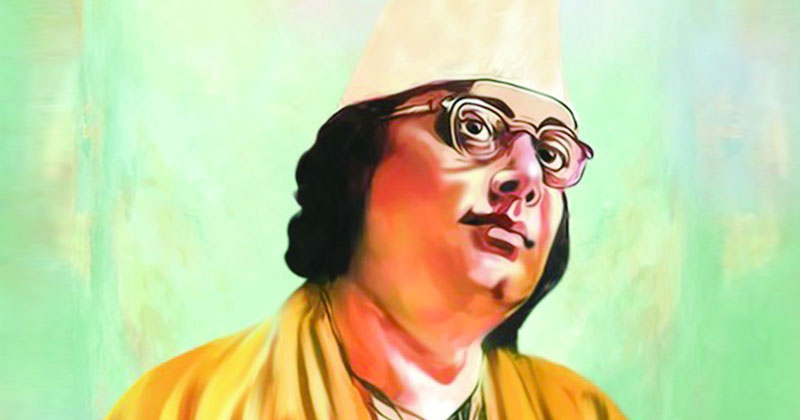
When the Kolkata police arrived to search Kazi Nazrul Islam’s house for banned books like Bisher Banshi, Bhangar Gaan, and Proloy Shikha, the poet did not resist. The officers turned the house upside down, scattering belongings everywhere, yet Nazrul remained calm and indifferent. But suddenly, the police noticed a small box in a corner. As they moved toward it, the rebel poet became frantic. He pleaded with the lead officer, “Do whatever you want, but please do not touch this box.” Ignoring his request, the police opened it. Inside were neatly arranged tiny clothes and toys belonging to Nazrul’s beloved son, Bulbul, who had passed away years earlier. The embarrassed officers saw tears shimmering in the poet’s eyes. Though celebrated in Bengali literature as the “Rebel Poet,” this deeply emotional side of Nazrul was revealed through the memories and interviews of his son, Kazi Sabyasachi. Nazrul adored his children and constantly worried about them. When little Bulbul died of smallpox at just four years old, the grief shattered him. Sabyasachi once said about his father, “I do not know how many people were blessed with such a generous-hearted father. In that sense, my brother and I were truly fortunate.” Sabyasachi’s nickname was “Sani,” inspired by Chinese revolutionary leader Sun Yat-sen, whom Nazrul admired deeply. His younger brother, Kazi Aniruddha, was lovingly called “Nini,” after Vladimir Lenin. Nazrul had four sons in total. His first son, Krishna Muhammad, died in infancy, while Bulbul passed away at the age of four. ‘তোমার সানি যুদ্ধে যাবে মুখটি করে চাঁদ পানা কোল ন্যাওটা তোমার নিনি বোমার ভয়ে আধখানা…’ He also made up another playful rhyme for the two brothers: ‘সানি নিনি দুই ভাই ব্যাং মারে ঠুইঠাই।’ Whenever Nazrul traveled away from home, he regularly wrote letters to his sons. Every letter ended with the same affectionate line: “Take my kisses. Yours, Baba.” Before falling seriously ill, Nazrul once dreamed of building a home in Baguiati, Kolkata. He even paid an advance for several bighas of land there. He would often take his family to visit the site and excitedly describe his plans: a bungalow-style house with a pond in the middle, fish in the water, and rooms arranged carefully for the family. He especially worried about little Nini going too close to the pond because the boy could not swim. But the dream never materialized. One day, while inspecting the land, Nazrul was disturbed by the foul smell of garbage carts passing nearby. Covering his nose with a handkerchief and applying perfume for himself and his sons, he firmly declared, “No, we will not build a house here. I won’t be able to write in this stench. My boys will fall sick.” Nazrul also loved taking his sons to football matches, theaters, and cinemas. Once, during an IFA Shield match between Mohammedan Sporting and K.C.B., he suddenly realized Sani and Nini were missing in the crowd. Panic-stricken, he began shouting, “Where is Sani? Where is Nini?” The entire stadium stared in shock until the boys were finally found and safely brought home in a taxi. Yet Nazrul’s affection was balanced with discipline. One afternoon, while the adults were busy playing cards, young Sabyasachi and Aniruddha decided to experiment with matches. Soon, they accidentally set a sofa on fire, and within moments the room was engulfed in flames. When Nazrul discovered what had happened, he glared at the boys with such fierce anger that both brothers trembled in fear.
Bangladesh Became Nazrul’s Final Home Through Bangabandhu’s Vision
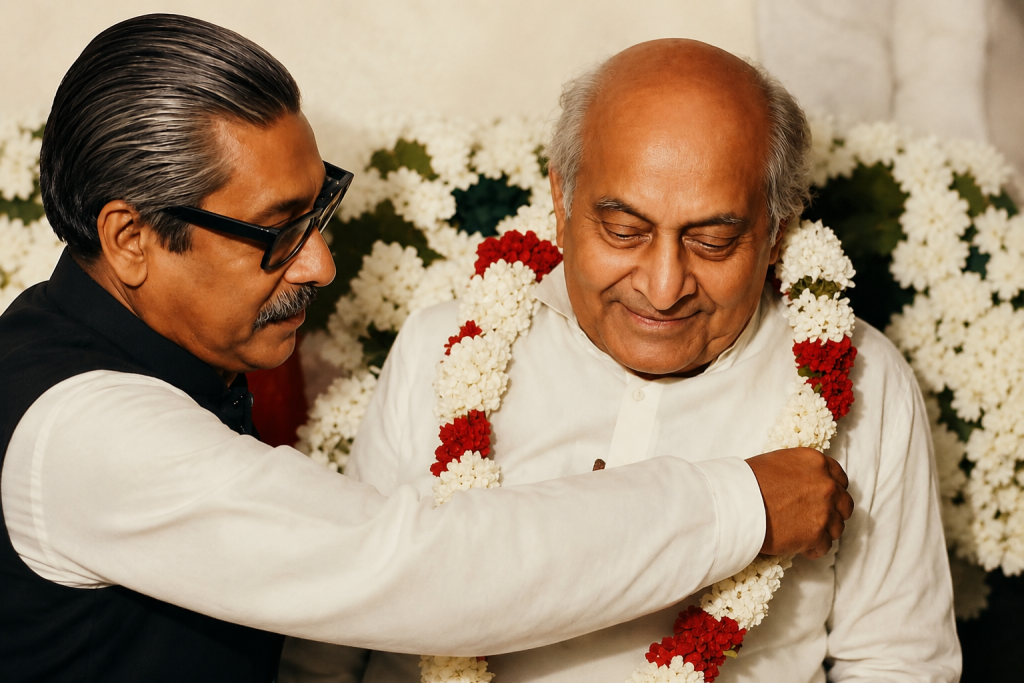
The final refuge of the Rebel Poet Kazi Nazrul Islam was Bangladesh and behind this historic chapter stood Sheikh Mujibur Rahman. As the architect of an independent Bangladesh, Bangabandhu not only built a new nation but also laid the foundation of its cultural identity. One of the most remarkable examples of this vision was his initiative to bring Nazrul to Bangladesh with full state honors. Nazrul shared a deep emotional connection with the land that later became Bangladesh. Although he was born in Bardhaman, in present-day India, he frequently visited East Bengal throughout his life. He traveled to Dhaka, Cumilla, Chattogram, Barishal, Mymensingh, Sylhet, Rajshahi, and many other regions for literary events, political activities, and personal visits. In 1926, he even contested the Indian Legislative Assembly election from the Dhaka–Faridpur constituency. The people of Bengal embraced him with immense affection, especially in Cumilla, where Birajasundari Devi treated him with motherly love. After independence, Bangabandhu Sheikh Mujibur Rahman envisioned a secular and culturally inclusive Bangladesh. He adopted songs of Rabindranath Tagore as the national anthem and recognized Nazrul’s songs as the nation’s marching spirit. Through this symbolic balance, Bangladesh established a cultural identity rooted in both Rabindranath and Nazrul. Bangabandhu realized that Nazrul ,the poet who had once voiced the dream of freedom across the subcontinent — was living in neglect and isolation in West Bengal. Determined to honor him properly, Bangabandhu decided to bring the poet to Bangladesh and celebrate his 73rd birthday with state recognition. During his visit to Kolkata in February 1972, he discussed the matter with the Governor of West Bengal and later with Indian Prime Minister Indira Gandhi. Diplomatic efforts and formal communications soon followed. The responsibility of bringing Nazrul to Bangladesh was given to then minister Matiur Rahman and cultural figure Mustafa Sarwar. After extensive discussions and overcoming family disagreements, Nazrul finally arrived in Dhaka on May 24, 1972, aboard a special flight of Biman Bangladesh Airlines. Thousands of emotional admirers gathered at Tejgaon Airport to welcome the poet. The crowd became so overwhelming that authorities had to secretly escort him out through the rear door of the aircraft and transport him by ambulance to his residence in Dhanmondi. Bangabandhu personally named the residence “Kobi Bhaban,” which later became the Nazrul Institute. Nazrul was received there with full state honor. Bangabandhu ensured every possible comfort for the poet and his family, even increasing his pension significantly. After a lifetime of financial hardship, Nazrul finally experienced dignity, stability, and national recognition in Dhaka. The love of the people of Bangladesh for Nazrul continued to grow after his arrival. In 1974, University of Dhaka awarded him an honorary D.Lit degree. In 1976, the government decided to confer the Ekushey Padak upon him and officially granted him Bangladeshi citizenship before doing so. On August 29, 1976, at the age of 77, Nazrul breathed his last at PG Hospital in Dhaka. Though the voice of the Rebel Poet fell silent, Bangladesh embraced him forever as its National Poet. Today, he rests beside the central mosque of the University of Dhaka in the land he deeply loved. Nazrul’s permanent settlement in Bangladesh was more than the relocation of a poet; it symbolized the cultural soul of a newly independent nation. Through Bangabandhu’s foresight and deep respect for culture, Bangladesh became the final home of Kazi Nazrul Islam.