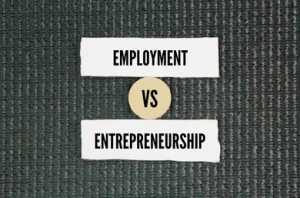


People often ask a deceptively simple question: Which is easier, becoming an entrepreneur or an employee?
At first glance, the answer appears obvious. Employees enjoy structured career paths, defined responsibilities, and a relatively predictable income. Entrepreneurs, on the other hand, face uncertainty, financial risk, and the constant challenge of building something from nothing.
Yet the more closely we examine both paths, the more complicated the question becomes.Behind every successful entrepreneur lies a story of risk, sacrifice, and resilience. Behind every accomplished employee lies years of discipline, expertise, and consistent performance. Both journeys demand hard work. Both require persistence. And neither offers a guaranteed route to success.
The answer, therefore, is neither. The real difference lies in the type of risk each path asks you to accept.
As an employee, your greatest asset is competence. If you perform well, opportunities generally follow. The organization provides structure, resources, training, and a relatively clear definition of success. Your income may rise or fall, but the rules of the game are visible.
Entrepreneurship is different. The entrepreneur begins with uncertainty and spends much of their journey trying to reduce it. There is no guaranteed salary, no established roadmap, and often no one to absorb the consequences of failure. Every major decision hiring, pricing, fundraising, or expansion carries financial and emotional weight.
In economic terms, employees are paid for managing tasks. Entrepreneurs are rewarded for absorbing uncertainty.
That distinction is critical. Research on entrepreneurship consistently shows that starting a business is not the hardest part; keeping it alive is. Many people launch businesses, but far fewer succeed in building organizations that survive long enough to become stable, job-creating enterprises.
This reality exposes one of the biggest myths surrounding entrepreneurship. We celebrate founders because we see the winners. We rarely see the thousands of entrepreneurs who spend years navigating cash-flow shortages, failed products, changing markets, and personal financial risk.
Yet entrepreneurship offers something uniquely powerful: leverage. An employee can create value through effort. An entrepreneur can create systems that continue generating value even when they are not present. That possibility explains why entrepreneurship continues to attract ambitious people despite its risks.
But there is another misconception worth challenging. Modern culture often portrays entrepreneurship as superior to employment. Social media celebrates founders, investors, and startup success stories while treating employment as a less ambitious choice.
This is a false comparison. Every successful company depends on exceptional employees. Apple needed engineers. Goldman Sachs needs analysts. Tesla needs designers. Microsoft needs managers. Even the most visionary entrepreneur ultimately succeeds by building a team of talented people.
Without great employees, entrepreneurship remains an idea.
Without entrepreneurs, employees have fewer opportunities.
The two are not rivals. They are interdependent.
Perhaps the better question is not whether entrepreneurship or employment is easier.
Instead, ask yourself: Which type of difficulty suits you best?
Do you prefer the challenge of mastering an existing system?
Or do you prefer the challenge of creating one from scratch?
One path rewards specialization and execution. The other rewards risk tolerance and resilience.
One offers stability in exchange for limited control.
The other offers control in exchange for constant uncertainty.
Neither is inherently better.
Neither is inherently easier.
Both require sacrifice. Both require courage. Both demand years of learning and adaptation.
Success is rarely determined by whether you become an entrepreneur or an employee. It is determined by whether you understand the trade-offs of your chosen path and are willing to pay the price that comes with it.
Because every meaningful career is difficult. The only question is whether the difficulty you choose is one you can live with.