ICT Syndicate Remains Unchanged Despite Power Shift: Is the New Center of Power Trapped in the Political Net of the Hasina-Joy and Palak-Sami Axis?

Although the government of Sheikh Hasina fell following the historic student-people mass uprising of July-August, the roots of the sinister force occupying the country’s Information and Communication Technology (ICT) and startup sectors have not yet been uprooted. The former Minister of State for ICT, Zunaid Ahmed Palak, and the controversial former Managing Director (MD) of Startup Bangladesh Limited, Sami Ahmed, were the main implementers of the “Smart Bangladesh” agenda of former Prime Minister Sheikh Hasina and her former ICT advisor, Sajeeb Wazed Joy. There are allegations that under the direct patronage of this Joy-Palak-Sami political triangle, state funds worth hundreds of crores of Taka, project tenders, and international exposure within the ICT sector were funneled into the pockets of a specific beneficiary syndicate. At the center of this beneficiary axis were a few platforms like ShareTrip, Anchorless Bangladesh, Agroshift, Chaldal, ShopUp, and GoZayaan. The primary objective of the “Digital and Smart Bangladesh” created by Sajeeb Wazed Joy and Palak was to polish their political image and build a personal venture network. Sami Ahmed was placed in the top position of Startup Bangladesh primarily due to his personal closeness to Joy and Palak. Despite managing public funds, he focused on protecting the political interests of the Awami government and granting funds to specific companies instead of remaining neutral. A chilling picture emerges when analyzing how the large startups sheltered under this sphere swallowed the entire ecosystem. ShareTrip was showcased at almost every national and international ICT event, alongside receiving crores of Taka in government equity investment. Chaldal received follow-on funding multiple times despite already dominating the market. ShopUp and GoZayaan secured an almost exclusive presence in Palak’s policy-making forums. Agroshift and Anchorless Bangladesh received special privileges in state grants and international roadshows. Policy advantages and prized tenders always went to this syndicate. As a result, promising independent startups were pushed out of funding and market competition. Even during the bloody student-people movement, Palak and Sami Ahmed tried to save the government’s image by organizing a “Startup Summit.” Although Palak and Sami Ahmed were removed after Sheikh Hasina fled, the core funding platforms of the sphere they built are now attempting to shed their skins in the new political reality. Crowding around the new centers of power, they are seeking to cover up their past misdeeds and scheming to grab state benefits once again. The tech community says that if this “ICT crony capitalism” created by the Hasina-Joy-Palak axis is not completely uprooted, merit will not be evaluated in the new Bangladesh achieved through the blood of the youth. Demands are immediately arising to publicly release audit reports of all venture investments, ICT tenders, and events conducted over the past 15 years.
How Artificial Intelligence Changed the Way I Learn

We live in a world where everything is moving fast. As a student, I always felt overwhelmed by the sheer amount of syllabi, assignments, and exams. I used to spend hours reading pages after pages, yet I struggled to remember things during exams. It felt like I was working hard, but not working smart. Then, everything changed when I started using AI for my studies. Honestly, at first, I thought AI was just for tech geniuses or computer scientists. But once I actually gave it a try, I realized it is the ultimate tool for “smart study.” It completely transformed my daily learning routine. Here is how AI helped me study smarter, not harder, and how it can help you too. My Personal, 24/7 Home Tutor In the past, whenever I got stuck on a difficult math problem or a confusing science concept late at night, I had to wait until the next day to ask a teacher or a friend. Sometimes, I even forgot what my doubt was! With AI, that problem is gone. Now, I can just type my question into an AI tool, and it explains the topic to me instantly. The best part? I can say to it, “Explain this to me like I am a ten-year-old.” It breaks down complex topics into simple sentences without using any hard vocabulary. It never gets tired or annoyed, no matter how many times I ask the same question. No More Boring Summaries Reading a 50-page chapter just to understand one core concept used to take me hours. Now, I use AI to get the main points. I upload the text or paste the article and ask the AI to give me a bullet-point summary of the most important ideas. This saves me a huge amount of time. Instead of wasting energy on reading fluff, I can focus my energy on understanding and memorizing the core information. Making Custom Quizzes We all know that just reading a book is not enough to pass an exam. You need to test yourself. Before AI, I had to look for old question papers or buy extra practice books. Now, I just tell the AI, “Create a 10-question multiple-choice quiz based on this chapter.” Boom! In five seconds, I have a personalized test ready. It helps me find out exactly which parts of the chapter I am weak in, so I can study those parts again. Planning My Day I used to be terrible at time management. I would make a study routine, but it was always too unrealistic to follow. Now, I tell the AI my schedule. For example, I say, “I have an exam in two weeks, and I can study for two hours every day. Create a simple study plan for me.” The AI creates a perfect daily schedule that breaks down my syllabus into small, achievable tasks. It takes away all the stress of planning. A Important Lesson I Learned While AI is amazing, I learned one big lesson from my own experience: AI is a helper, not a replacement for your brain. In the beginning, I made the mistake of letting AI write an entire assignment for me. When my teacher asked me questions about it the next day, I had no answers. I felt so embarrassed. That is when I realized that copying and pasting is not “Smart Study.” Smart study means using AI to understand the topic, and then writing it down in your own words. Use AI to generate ideas, to brainstorm, and to clear your doubts. Don’t let it do all your thinking for you. AI has made studying feel less like a burden and more like a game. It helped me save time, reduce my exam stress, and actually enjoy learning new things. If you are still studying the old-fashioned way, you are missing out. Give AI a try today, change your habits, and start studying smart!
Artificial Intelligence in Education: a Tool, Not a Replacement

Artificial Intelligence (AI) is the simulation of human intelligence processed by machines, particularly computer systems. AI refers to the ability of machines (software or hardware) to perform tasks that typically require human intelligence, such as learning, reasoning, perception, problem-solving, and creativity. The rapid advancement of AI is transforming nearly every sector, and education is no exception. From personalized tutoring systems to automated grading and intelligent content recommendations, AI promises to make learning more effective, accessible, and efficient. However, as schools, universities, and edtech companies rush to integrate these tools, a critical principle must guide their adoption: AI should be a powerful tool to enhance teaching and learning, not a replacement for human educators or irreplaceable human elements of education. AI is one of the powerful drivers that brought a revolutionary change in education by offering transformative opportunities for the education system. It improves the effectiveness and ensures quality. It gives the teaching and learning services at a minimal amount of cost or cost-free. In most countries, some educational resources, such as AI text generators, AI tools, etc., are commonly used by the teachers and students in the classroom. As the AI (GenAI) tools are generally available and outgoing, the govt. is failing to create rules for them. This leaves our private data unprotected and schools unprepared to safely check or use these tools. This humanistic guidance calls for AI regulations like strong data privacy protection and age limits for kids’ independent AI chats while promoting human-centered, age-appropriate ethical use in education and research. We can have personalized learning, instant feedback, 24/7 learning assistance, translations, data analysis, etc. benefits from AI. Treating AI as a substitute risks undermining the relational, creative, and ethical dimensions that define good education. Though AI can answer within seconds, it cannot be replaced with teachers. Teachers can understand emotions, give motivations, build confidence, encourage and guide teamwork, and teach ethics and values, which AI can’t. We have to remember that a teacher is a human being, so he can understand a student well, but AI is nothing but a generated computer. So, it lacks empathy and real-life experience. For years, AI quietly helped with grading and tests in schools, but most people didn’t notice. Then generative AI suddenly arrived on students’ and teachers’ devices, which has changed everything. These AI-generated tools can write essays, solve problems, and do tasks for us. They weren’t meant for learning. This sparked big worries about cheating and grades, such as students making fake results, admitting cards, and cheating in exams. Also, students are not using their brains. Rather, they are getting completely dependent on AI. Sometimes, AI can make mistakes, but students are using the information blindly without judging it. Also, their critical thinking capacity is getting reduced day by day. As AI is transforming education by making learning more individualized, effective, and accessible, we can use it as a guideline, not a replacement. We also have to verify the facts using reliable sources. Teachers also should integrate AI lessons responsibly. Education is fundamentally a human process based on communication, empathy, creativity, and mentorship. The future of education lies not in replacing teachers with artificial intelligence, but in empowering teachers and students to use AI responsibly as a tool for better learning.
How Bangladeshi Freelancers Are Secretly Building the AI Revolution

When you type a question into an AI chatbot and get a perfect, smart answer in seconds, it feels like magic. We often think that Artificial Intelligence is a super-smart machine that learns everything by itself. But that is a big misunderstanding. The truth is, AI cannot learn on its own. Behind every smart, accurate, and safe answer given by an AI, there is a real human being working hard behind a computer screen. These workers are called Data Annotators. They are the ones who clean up the AI’s mistakes, fix its messy language, and block it from saying harmful things. What is even more amazing is that Bangladesh has become a global superpower in this industry. Today, Bangladeshi freelancers make up about 15% of the entire global freelancing market on websites like Upwork and Fiverr. They are the invisible army shaping the future of technology. The Secret Life of a Data Annotator To understand why this is such a big deal, we have to look at what these freelancers actually do every day. An AI model starts out like a blank notebook. It does not know the difference between right and wrong, or between a cat and a dog. Tech companies need humans to teach the AI, and this is where Bangladeshi freelancers come in. One of their most important jobs is something called “Red-Teaming.” This sounds like a military term, and in a way, it is. Freelancers act like hackers or testers who intentionally try to break the AI. They ask the chatbot tricky questions, try to make it angry, or trick it into giving illegal advice. When the AI fails, the freelancer marks the mistake so the engineers can fix it. This keeps the AI safe for the public. Apart from that, they do a massive amount of data labeling and tagging. If an AI needs to recognize cars on the road for self-driving technology, thousands of photos of roads must be manually tagged. A human has to draw a box around every car, traffic light, and pedestrian in a photo so the AI can learn what they look like. Bangladeshi freelancers spend hours doing this detailed work, along with listening to audio clips to type them out for voice-recognition AI. Why Global Companies Love Bangladeshi Freelancers It is not an accident that 15% of the world’s online marketplace is filled with workers from Bangladesh. International companies actively look for Bangladeshi talent for a few major reasons. First of all, the youth of Bangladesh are incredibly quick learners. As the world shifted from simple data entry to complex AI training, Bangladeshi freelancers upgraded their skills almost overnight. They learned how to talk to AI, how to grade its logic, and how to spot bias in machine learning. Second, Bangladesh offers high-quality work at a very competitive price. Because the cost of living in Bangladesh is much lower than in countries like the USA, UK, or Australia, local freelancers can afford to charge rates that are highly attractive to global tech giants. This affordability makes them the top choice for companies that need thousands of hours of data work done without breaking the bank. A Massive Financial Blessing for Bangladesh This massive wave of freelancing is doing wonders for the country’s economy. These are not just young people earning a little bit of pocket money. This is a massive professional industry that brings huge amounts of foreign currency directly into the country. During the 2024-25 financial year, Bangladeshi freelancers brought in a staggering $725 million in remittances. In local currency, that is around 8,500 Crore BDT. When a freelancer gets paid in US dollars, that money enters the Bangladeshi banking system and helps the entire nation’s economy grow stronger. It creates jobs, powers local businesses, and gives thousands of families a better standard of living. The Road Ahead for the Digital Nation The AI industry is growing faster than almost any other industry in human history. As tech giants build bigger and more complex AI systems, they will need even more humans to test, train, and fix those systems. For Bangladesh, this is a golden ticket to the future. By focusing more on teaching young people good English communication skills and basic computer literacy, Bangladesh can easily grow its share from 15% to an even higher number. The hardworking youth of the country have already proven that they can compete with the best in the world, and they are just getting started.
The End of an Era? Why OpenAI’s New ‘Jalapeño’ Chip is a Direct Strike at Nvidia’s AI Throne
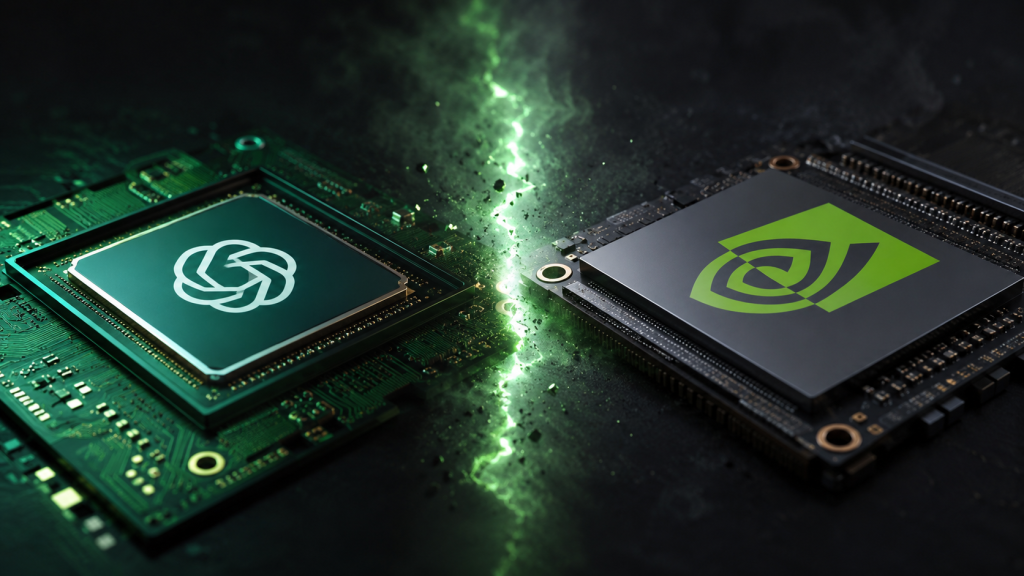
The artificial intelligence industry recently witnessed a seismic paradigm shift. OpenAI, a company globally renowned for defining the modern AI software era with ChatGPT, has officially crossed the Rubicon into custom hardware. Its weapon of choice is a proprietary, custom-designed silicon chip codenamed Jalapeño. This move into silicon is far more than an experimental side project; it is an aggressive, calculated offensive designed to break OpenAI’s structural and financial reliance on Nvidia. The announcement instantly sent shockwaves through Wall Street and Silicon Valley alike. Fear of a shifting status quo triggered a massive selloff in semiconductor stocks. Industry titans Nvidia, AMD, and Micron all watched their share prices tumble as investors suddenly faced a reality they had not seriously considered for years: the potential erosion of Nvidia’s absolute market dominance. The Birth of Jalapeño: A Speed Record in Silicon To bring Jalapeño to life, OpenAI bypassed the traditional, agonizingly slow hardware development cycles by forming a tight strategic alliance with Broadcom. Jalapeño is an Application-Specific Integrated Circuit (ASIC). Unlike general-purpose graphics processing units (GPUs), which are built to handle a wide variety of computational tasks, an ASIC is laser-focused. Jalapeño was engineered from the substrate up for a singular, high-stakes mission: AI inference. While training is the resource-heavy process of teaching an AI model using massive datasets, inference is the operational phase. It occurs every time a user types a prompt into ChatGPT and the model processes that data to generate a real-time response. Inference represents the day-to-day operational cost of running AI at a global scale. What has left hardware engineers astonished is the sheer velocity of Jalapeño’s development. Under normal circumstances, a cutting-edge AI chip requires three to five years to progress from architectural concepts to a final manufacturing “tape-out” the point where the design is sent to a foundry like TSMC for production. Jalapeño completed this entire journey in just nine months. OpenAI achieved this unprecedented timeline by turning its own technology inward. Engineers used advanced, proprietary large language models to automate and optimize the chip’s microarchitecture, verify circuits, and route complex physical layouts. This has initiated a profound, recursive loop where current-generation AI software is actively designing the next-generation hardware required to run future AI. By compressing the development timeline by years, OpenAI has fundamentally rewritten the rules of silicon engineering. Why This is a Direct Threat to Nvidia’s Business For the past several years, Nvidia has enjoyed what amounted to a sovereign monopoly over the AI ecosystem. Its hardware has been the gold standard, allowing the company to command staggering 75% gross margins and dictate premium pricing to desperate tech giants. OpenAI’s Jalapeño is designed to completely shatter that pricing power across three critical fronts. First, running inference for hundreds of millions of active users is a massive financial burden for OpenAI. However, Broadcom CEO Hock Tan recently revealed that early testing of Jalapeño yielded jaw-dropping results: the ASIC delivers a roughly 50% cost savings compared to equivalent Nvidia architectures when running specialized inference workloads. For a company spending billions annually on compute, cutting operational hardware costs in half is an existential victory. Second, by designing its own silicon, OpenAI drastically reduces its vulnerability to Nvidia’s notorious supply chain bottlenecks. OpenAI no longer has to wait in line or pay a premium for hardware allocations. Furthermore, because Jalapeño is bespoke, OpenAI can fine-tune the silicon specifically to optimize the underlying transformer architectures of models like ChatGPT, Sora, and Codex. This results in an ecosystem where software and hardware are perfectly tuned to each other, resulting in blindingly fast user response times at a fraction of the power consumption. Third, in a maneuver that directly bleeds Nvidia’s sales pipeline, Microsoft OpenAI’s primary cloud partner and one of Nvidia’s single largest customers has reportedly stepped in with a massive commitment. Microsoft has agreed to absorb 40% of the initial Jalapeño chip output. These chips will be deployed directly into Azure data centers to power Microsoft’s Copilot and Azure AI services, pulling a massive amount of capital right out of Nvidia’s revenue stream. The “Inference” vs. “Training” Battleground To properly evaluate this hardware war, one must understand the distinct dichotomy between the two phases of artificial intelligence compute. Jalapeño is explicitly an inference-only chip, built to process live user prompts rather than train models from scratch. For the immediate future, Nvidia’s crown jewel remains secure. OpenAI will continue to purchase and utilize Nvidia’s ultra-powerful GPU architectures to train its cutting-edge frontier models. Training a model requires processing chaotic, petabyte-scale datasets, demanding a level of architectural flexibility and raw brute force that only Nvidia’s general-purpose processors can currently provide. However, Nvidia cannot afford to be complacent. OpenAI has openly confirmed that Jalapeño is merely Phase 1 of a broader hardware roadmap. The company is already actively exploring an expansion of its custom silicon initiative into model training chips. If OpenAI successfully replicates its nine-month development miracle for a training ASIC, it will land a devastating, direct strike to Nvidia’s primary profit engine. Can Nvidia Maintain Its Moat? Despite the Wall Street panic, many hardware purists and market analysts argue that Nvidia remains in an entirely different league. It will take years for any competitor even one backed by OpenAI and Microsoft to truly dethrone the king, thanks to several structural advantages. Nvidia routinely pulls in more data center revenue in a single quarter ($75.2 billion) than Broadcom expects to generate from its entire AI chip portfolio across a whole fiscal year. Nvidia’s financial war chest allows it to out-invest any competitor on earth in research and development. Furthermore, Nvidia’s true secret weapon isn’t its silicon; it’s CUDA (Compute Unified Device Architecture). For over fifteen years, global developers have built their AI software libraries on top of Nvidia’s proprietary CUDA ecosystem. Custom chips like Jalapeño cannot natively run CUDA software. Breaking this developer lock-in requires a monumental shifting of industry-wide software standards. Finally, the global demand for AI compute is growing exponentially. Even if OpenAI completely replaces Nvidia chips
The Comprehensive Guide to Data Science: Transforming the Digital World

Data science is a multifaceted, interdisciplinary academic field that uses scientific methods, statistics, scientific computing, algorithms, and systems to extract knowledge and insights from data. It is often described as the “fourth paradigm” of science following empirical, theoretical, and computational research because it is purely data-driven. In our modern world, everyday activities like social media scrolling, online shopping, and sensor use generate millions of terabytes of data each day. Data science turns this “chaotic mix” of signals into meaningful information for smart decision-making. The History and Evolution of Data Science The journey of data science is rooted in the convergence of statistics and computer science. 1962: John Tukey described “data analysis” as an empirical science focused on deriving meaning rather than just theoretical math. 1974: Peter Naur proposed the term “data science” as a better alternative to “computer science” to reflect an emphasis on data-driven methods. 1985–1997: C.F. Jeff Wu suggested statistics be renamed “data science” to help the field shed old stereotypes of being limited to simple accounting. 2001: William S. Cleveland outlined a vision for an independent discipline that integrated machine learning and computing. 2008–2012: The title “Data Scientist” was formalized by DJ Patil and Jeff Hammerbacher. Soon after, it was famously declared the “Sexiest Job of the 21st Century”. The Data Science Life Cycle Turning raw data into intelligence follows a structured cycle where each phase builds on the last: Obtaining Data: Gathering relevant raw data from databases, sensors, IoT devices, APIs, and online platforms. Cleaning Data (Data Wrangling): Formatting data and handling missing values, duplicates, and errors. Data scientists often spend the majority of their time here to ensure reliability. Exploring Data (EDA): Using statistics and visualization to identify underlying structures, patterns, and anomalies. Modeling Data: Applying machine learning algorithms to predict outcomes or explain relationships (e.g., forecasting future sales). Interpreting Results: Communicating findings clearly to stakeholders using visualization and storytelling to aid decision-making. Core Techniques of Analysis Data science uses four primary analytical approaches depending on the goal: Descriptive Analysis: Summarizing what happened using averages and frequencies (e.g., average customer spending). Diagnostic Analysis: Investigating why something happened (e.g., why hospital readmission rates are high). Predictive Analysis: Estimating what is likely to happen in the future using historical patterns and models. Prescriptive Analysis: Recommending specific actions to take based on insights. A Deep Dive into Machine Learning (ML) Machine learning is the “brain” of data science, training computers to learn from data. It is categorized into several main types: Supervised Learning The computer learns from labeled data, where the correct answer is already known. Key algorithms include: Decision Trees: Intuitive models that partition data into binary decisions. They are easy to interpret but prone to overfitting. Support Vector Machines (SVM): Powerful classifiers effective in high-dimensional spaces and robust to noise. Neural Networks: Inspired by the human brain, these consist of interconnected neurons that perform nonlinear transformations. Deep Neural Networks (DNNs) are capable of learning complex patterns from raw data but require massive computing resources. Unsupervised Learning The computer finds hidden patterns in unlabeled data. Clustering: Grouping similar items (e.g., k-means). Dimensionality Reduction: Simplifying data while keeping its main features (e.g., Principal Component Analysis or PCA). Reinforcement Learning An agent learns by interacting with its environment, receiving rewards or punishments based on its actions. This is highly effective for robotics, autonomous navigation, and game playing. Advanced Methods Ensemble Learning: Combining multiple models to improve accuracy. This includes Bagging (Random Forests), Boosting (AdaBoost, GBM), and Stacking. Deep Learning Specialized Architectures: CNNs (for images), RNNs (for sequential data like stock prices), and Transformers (for natural language tasks like translation). Time Series Analysis: Using historical observations to forecast the future (e.g., ARIMA, Exponential Smoothing, or LSTM networks). Technical Infrastructure and Tools Data science relies on a robust set of tools and scalable architectures: Programming Languages: Python (valued for versatility and simplicity), R (excellent for statistical research), and SQL (essential for querying structured data). Big Data & Cloud: Platforms like Apache Spark, Hadoop, and Databricks allow for parallel processing of massive datasets. Cloud platforms like AWS, Google Cloud, and Azure provide the necessary storage and power. Scalability: Systems can scale horizontally (adding more computers) or vertically (adding more power to a single computer) to handle growing data volumes. Notebooks: Platforms like Anaconda Notebooks allow users to code in the browser instantly with pre-installed libraries like Pandas and Scikit-learn. Real-World Applications Data science is transformative across diverse sectors: Healthcare: Used for disease diagnosis, medical imaging (X-rays/MRIs), medication development, and personalized treatment. Human Well-being & Mental Health: Artificial Emotional Intelligence (AEI) helps technology understand human emotions. One major project uses mobile apps to provide collaborative care for cancer patients with depression by tracking moods and helping social workers intervene at the right time. Finance: Algorithms detect fraud in real-time, perform algorithmic trading, and assess creditworthiness. Retail & Marketing: Predicting stock needs for festivals, providing personalized recommendations (like Netflix or Amazon), and analyzing customer sentiment. Cybersecurity: Enhancing digital security through smart, automated decision-making to flag unusual transaction patterns. Environment: Climate change modeling, resource management, and tracking biodiversity. Career Paths and Success Strategies The field is open to those from non-technical backgrounds, such as biology or publishing, provided they upskill. Roles: Data Analysts interpret history, Data Scientists predict the future, ML Engineers build production systems, Data Engineers build the infrastructure. Technical Skills: Mastery of Python, SQL, statistics, and linear algebra is essential. Soft Skills: The ability to speak the “language of business” rather than just technical jargon is critical. Data scientists must be able to tell a story with data to show how it drives business value. Expert Advice: The best way to learn is to do data science. Building a portfolio of real-world projects is often more valuable than certifications alone for proving your skills to employers. Challenges, Ethics, and the Future As the field advances, it faces significant hurdles: Privacy & Bias: Protecting sensitive data and ensuring algorithms do not perpetuate human prejudices found in historical data. Ethics: Professionals must develop ethical
THE COMPANY THAT ACCIDENTALLY BECAME THE INTERNET’S ENGINE ROOM
NVIDIA set out to make graphics cards for gamers. Three decades later, it quietly ended up owning the hardware that runs modern artificial intelligence and, with it, an uncomfortable amount of leverage over the entire tech world. There is a strange kind of power that comes not from being the biggest, the loudest, or the most aggressive, but from being the thing everything else quietly depends on. NVIDIA has that kind of power. It is infrastructure power. The kind that makes itself felt not in press releases or keynote speeches but in the cold arithmetic of what breaks if you take it away. Think about what runs a modern AI model. Not the software. Not the algorithm written by some PhD who drinks too much coffee. The actual computation, the billions of matrix multiplications per second that translate a text prompt into a coherent paragraph or a chest X-ray scan into a diagnosis. That computation, in an overwhelming share of cases, happens on NVIDIA hardware. Specifically on chips branded H100 or A100, cooled by industrial fans in data centers the size of aircraft hangars, owned by Amazon or Microsoft or Google, and quietly rented out by the second to thousands of companies and researchers around the world. NVIDIA did not plan any of this. Or at least, not all of it. Jensen Huang, who co-founded the company in a Denny’s diner in California in 1993, wanted to build graphics processors. The GPU was a product aimed squarely at gamers who wanted smoother frame rates and more realistic explosions. For most of the 1990s and 2000s, that is exactly what NVIDIA was: a very good, very focused graphics chip company, locked in a fierce rivalry with ATI (later absorbed by AMD) over who could render more polygons per second. CUDA: THE BET THAT CHANGED EVERYTHING The real turning point was not a product. It was a software decision that, at the time, looked to most observers like a strange and expensive vanity project. In 2006, NVIDIA released CUDA, Compute Unified Device Architecture. The idea was simple but radical: let developers program GPUs not just for graphics, but for any highly parallel computation. GPUs, it turns out, are structurally different from CPUs. Where a CPU has a handful of very powerful cores optimized for sequential tasks, a GPU has thousands of smaller cores that can all run simultaneously. For graphics, this made sense. Rendering pixels is embarrassingly parallel work. But it also made GPUs extraordinarily well suited for anything that required doing many similar calculations at once. Things like simulating physics. Doing financial modeling. And, as it turned out, training neural networks. The machine learning community noticed. A landmark 2012 paper by Geoffrey Hinton’s team at the University of Toronto, the famous AlexNet, used NVIDIA GPUs to train a deep neural network that blew past everything else in an image recognition competition. The speedup compared to CPU-based training was not marginal. It was transformative. Suddenly every serious AI researcher wanted NVIDIA hardware, and more importantly, they wanted CUDA, because years of libraries and tools had already been built on top of it. This is the part of the story that is easy to miss. The GPUs themselves are impressive hardware, but hardware can theoretically be replicated. What is harder to replicate is the software ecosystem. CUDA has had a twenty-year head start. Frameworks like TensorFlow and PyTorch are built around it. Research papers assume it. PhD students learn on it. When a new AI startup spins up and needs to train a model, they do not re-evaluate the chip ecosystem from first principles. They reach for what the entire field already knows how to use. That network effect is NVIDIA’s real moat, and it is deeper than most people outside the industry appreciate. THE DATA CENTER BECOMES THE PRODUCT For most of NVIDIA’s history, gaming was its bread and butter. GeForce graphics cards were what kept the lights on, and the company’s data center revenue was a smaller, growing, but secondary line of business. That changed with breathtaking speed. The arrival of large language models, GPT-3 in 2020, then the explosion of ChatGPT in late 2022, created demand for compute that the world had simply never seen before. Training a large language model requires not a single GPU but thousands of them, running in parallel for weeks or months at enormous cost. OpenAI’s GPT-4 training reportedly cost over $100 million in compute alone. The models that came after it were larger still. Every major tech company- Google, Meta, Amazon, Microsoft- embarked on their own AI infrastructure buildouts simultaneously. What followed was the GPU shortage that defined the AI industry’s awkward adolescence. Companies that had been planning to build AI products suddenly found themselves unable to get the hardware they needed. H100 chips that nominally cost around $30,000 were trading on secondary markets for two or three times that. Cloud access to GPU clusters was oversubscribed for months. Venture capitalists, in a genuinely surreal turn, began treating “GPU allocation” as a competitive advantage in due diligence conversations. Not code quality, not team pedigree, but raw access to NVIDIA chips. NVIDIA’s revenue figures tell the story numerically, but they do not fully capture the structural shift they represent. This is no longer a company whose primary customers are teenagers buying graphics cards. It is a company whose primary customers are the largest corporations on earth, purchasing infrastructure to build products that will define the next decade of the internet. WHAT THIS MEANS FOR THE REST OF THE INDUSTRY There is a paradox sitting at the heart of the relationship between NVIDIA and the major cloud providers. AWS, Google Cloud, and Microsoft Azure are simultaneously NVIDIA’s biggest customers and among its most motivated potential rivals. They buy NVIDIA GPUs in quantities that beggar belief, then rent access to those GPUs as one of their most profitable cloud services. Every time someone uses a cloud AI API, there is a reasonable chance an NVIDIA chip is involved, and a percentage
From Dishwasher to Architect of the AI Age
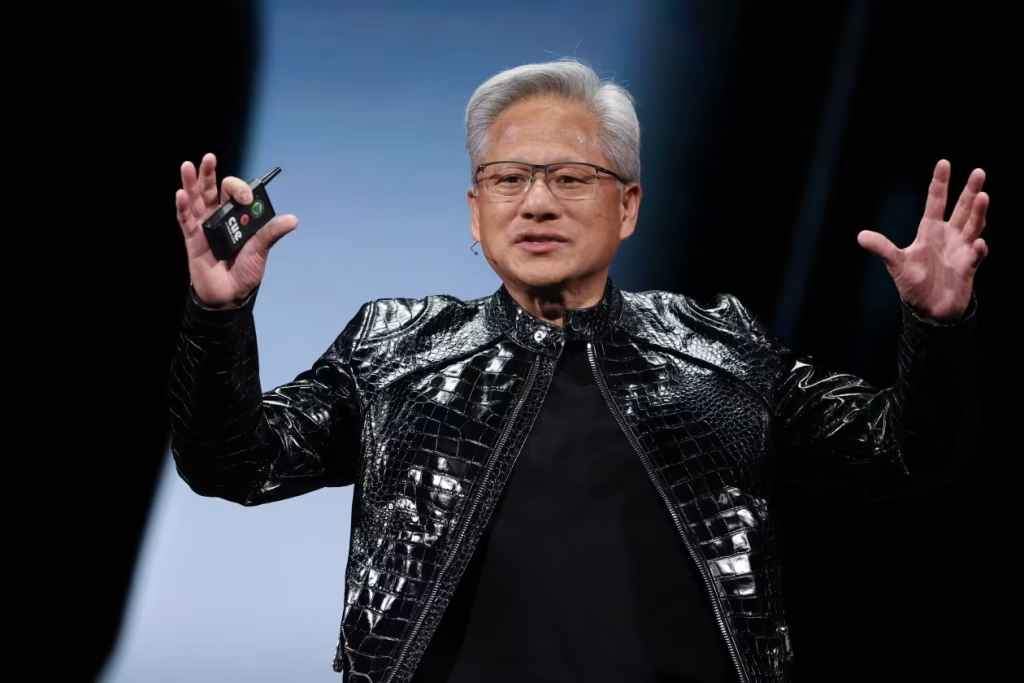
Some individuals in the history of technology possess a vision so profound that it not only transforms the destiny of a company but also shapes the course of an entire era. Jensen Huang is one of those rare figures, as the co-founder and Chief Executive Officer of NVIDIA. He is widely recognized as one of the principal architects of the modern Artificial Intelligence (AI) revolution. In his own words, “Curiosity is the most powerful force behind progress. Never stop asking questions and seeking answers.” Born in Taipei, Taiwan, in 1963, Jensen Huang spent part of his childhood there before immigrating to the United States with his family. Life in a new country was far from easy. Alongside his studies, he worked various part-time jobs to support himself, including serving as a busboy and cleaning tables in restaurants. These early struggles taught him the true value of hard work, discipline, and perseverance. As Huang often says, Never think any job is beneath you. Every experience becomes the foundation for your future.” He earned a bachelor’s degree in Electrical Engineering from Oregon State University and later completed a master’s degree in the same field at Stanford University. Early in his career, he worked at AMD and LSI Logic, gaining valuable experience in the semiconductor industry. In 1993, at the age of just 30, Huang co-founded NVIDIA with two friends. Initially, the company’s focus was on developing Graphics Processing Units (GPUs) for gaming. However, Huang quickly recognized that the potential of GPUs extended far beyond gaming applications. His visionary leadership gradually transformed NVIDIA into a global powerhouse in artificial intelligence, data centers, robotics, scientific research, and supercomputing. Today, much of the world’s advanced AI infrastructure depends on NVIDIA’s GPU technology. As a result, technology analysts often refer to him as one of the architects of the AI era. According to Huang, “AI won’t directly take your job. Someone using AI effectively will.” One of the most inspiring and human aspects of Jensen Huang’s story is his personal life. While studying at Oregon State University, he met Lori Mills. Working together as laboratory partners, they developed a friendship that eventually blossomed into a romantic relationship. According to a popular story, Jensen once told Lori, “If you study with me, you’ll get an A.” After nearly five years together, they married in 1984. More than four decades later, their marriage remains remarkably strong and enduring. Huang has repeatedly acknowledged that Lori’s support has been one of his greatest sources of strength during challenging periods of his life. Reflecting on success and resilience, Huang has observed, “People with high expectations often have less patience and tolerance. Yet those qualities are essential foundations for long-term success.” As a leader, Jensen Huang firmly believes that no success is ever final. Complacency gradually weakens organizations, which is why he consistently emphasizes continuous learning, adaptation, and innovation as the only path forward. Another defining feature of Huang’s public image is his iconic black leather jacket, which has become almost synonymous with NVIDIA itself. He is frequently seen wearing it during major technology announcements and industry events, reflecting his simple yet confident personality. In 2007, Jensen and Lori Huang established the Jen-Hsun & Lori Huang Foundation, which has contributed significantly to education, science, healthcare, and technology research. In recognition of his extraordinary contributions, Huang has received numerous prestigious honors, including the IEEE Medal of Honor, IEEE Founders Medal, Robert N. Noyce Award, imec Lifetime of Innovation Award, Ernst & Young Entrepreneur of the Year, and honorary doctorates from several universities. Another of his powerful beliefs is, “The greatest risk is taking no risk at all.” From washing dishes and working in restaurants to leading one of the world’s most influential technology companies, Jensen Huang’s journey is far more than a success story. It is a remarkable testament to perseverance, curiosity, vision, and the power of meaningful human relationships. Jensen Huang has demonstrated that limited opportunities never have to stand in the way of ambitious dreams, provided one possesses the right mindset, relentless determination, and an unwavering commitment to learning. Perhaps no quote captures the essence of his life better than this, “If you are afraid of failure, you will never accomplish anything truly great.”