The End of an Era? Why OpenAI’s New ‘Jalapeño’ Chip is a Direct Strike at Nvidia’s AI Throne
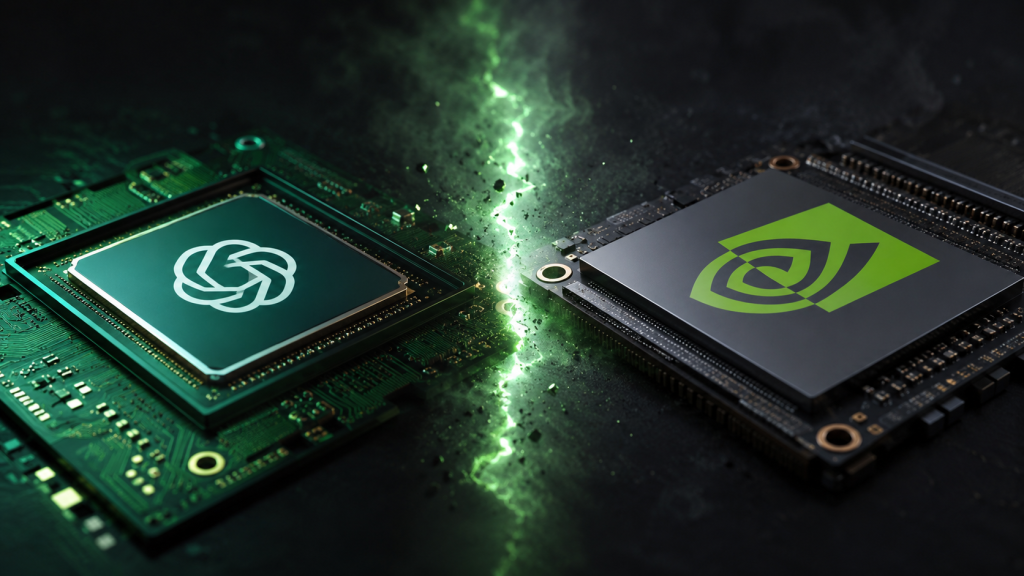
The artificial intelligence industry recently witnessed a seismic paradigm shift. OpenAI, a company globally renowned for defining the modern AI software era with ChatGPT, has officially crossed the Rubicon into custom hardware. Its weapon of choice is a proprietary, custom-designed silicon chip codenamed Jalapeño. This move into silicon is far more than an experimental side project; it is an aggressive, calculated offensive designed to break OpenAI’s structural and financial reliance on Nvidia. The announcement instantly sent shockwaves through Wall Street and Silicon Valley alike. Fear of a shifting status quo triggered a massive selloff in semiconductor stocks. Industry titans Nvidia, AMD, and Micron all watched their share prices tumble as investors suddenly faced a reality they had not seriously considered for years: the potential erosion of Nvidia’s absolute market dominance. The Birth of Jalapeño: A Speed Record in Silicon To bring Jalapeño to life, OpenAI bypassed the traditional, agonizingly slow hardware development cycles by forming a tight strategic alliance with Broadcom. Jalapeño is an Application-Specific Integrated Circuit (ASIC). Unlike general-purpose graphics processing units (GPUs), which are built to handle a wide variety of computational tasks, an ASIC is laser-focused. Jalapeño was engineered from the substrate up for a singular, high-stakes mission: AI inference. While training is the resource-heavy process of teaching an AI model using massive datasets, inference is the operational phase. It occurs every time a user types a prompt into ChatGPT and the model processes that data to generate a real-time response. Inference represents the day-to-day operational cost of running AI at a global scale. What has left hardware engineers astonished is the sheer velocity of Jalapeño’s development. Under normal circumstances, a cutting-edge AI chip requires three to five years to progress from architectural concepts to a final manufacturing “tape-out” the point where the design is sent to a foundry like TSMC for production. Jalapeño completed this entire journey in just nine months. OpenAI achieved this unprecedented timeline by turning its own technology inward. Engineers used advanced, proprietary large language models to automate and optimize the chip’s microarchitecture, verify circuits, and route complex physical layouts. This has initiated a profound, recursive loop where current-generation AI software is actively designing the next-generation hardware required to run future AI. By compressing the development timeline by years, OpenAI has fundamentally rewritten the rules of silicon engineering. Why This is a Direct Threat to Nvidia’s Business For the past several years, Nvidia has enjoyed what amounted to a sovereign monopoly over the AI ecosystem. Its hardware has been the gold standard, allowing the company to command staggering 75% gross margins and dictate premium pricing to desperate tech giants. OpenAI’s Jalapeño is designed to completely shatter that pricing power across three critical fronts. First, running inference for hundreds of millions of active users is a massive financial burden for OpenAI. However, Broadcom CEO Hock Tan recently revealed that early testing of Jalapeño yielded jaw-dropping results: the ASIC delivers a roughly 50% cost savings compared to equivalent Nvidia architectures when running specialized inference workloads. For a company spending billions annually on compute, cutting operational hardware costs in half is an existential victory. Second, by designing its own silicon, OpenAI drastically reduces its vulnerability to Nvidia’s notorious supply chain bottlenecks. OpenAI no longer has to wait in line or pay a premium for hardware allocations. Furthermore, because Jalapeño is bespoke, OpenAI can fine-tune the silicon specifically to optimize the underlying transformer architectures of models like ChatGPT, Sora, and Codex. This results in an ecosystem where software and hardware are perfectly tuned to each other, resulting in blindingly fast user response times at a fraction of the power consumption. Third, in a maneuver that directly bleeds Nvidia’s sales pipeline, Microsoft OpenAI’s primary cloud partner and one of Nvidia’s single largest customers has reportedly stepped in with a massive commitment. Microsoft has agreed to absorb 40% of the initial Jalapeño chip output. These chips will be deployed directly into Azure data centers to power Microsoft’s Copilot and Azure AI services, pulling a massive amount of capital right out of Nvidia’s revenue stream. The “Inference” vs. “Training” Battleground To properly evaluate this hardware war, one must understand the distinct dichotomy between the two phases of artificial intelligence compute. Jalapeño is explicitly an inference-only chip, built to process live user prompts rather than train models from scratch. For the immediate future, Nvidia’s crown jewel remains secure. OpenAI will continue to purchase and utilize Nvidia’s ultra-powerful GPU architectures to train its cutting-edge frontier models. Training a model requires processing chaotic, petabyte-scale datasets, demanding a level of architectural flexibility and raw brute force that only Nvidia’s general-purpose processors can currently provide. However, Nvidia cannot afford to be complacent. OpenAI has openly confirmed that Jalapeño is merely Phase 1 of a broader hardware roadmap. The company is already actively exploring an expansion of its custom silicon initiative into model training chips. If OpenAI successfully replicates its nine-month development miracle for a training ASIC, it will land a devastating, direct strike to Nvidia’s primary profit engine. Can Nvidia Maintain Its Moat? Despite the Wall Street panic, many hardware purists and market analysts argue that Nvidia remains in an entirely different league. It will take years for any competitor even one backed by OpenAI and Microsoft to truly dethrone the king, thanks to several structural advantages. Nvidia routinely pulls in more data center revenue in a single quarter ($75.2 billion) than Broadcom expects to generate from its entire AI chip portfolio across a whole fiscal year. Nvidia’s financial war chest allows it to out-invest any competitor on earth in research and development. Furthermore, Nvidia’s true secret weapon isn’t its silicon; it’s CUDA (Compute Unified Device Architecture). For over fifteen years, global developers have built their AI software libraries on top of Nvidia’s proprietary CUDA ecosystem. Custom chips like Jalapeño cannot natively run CUDA software. Breaking this developer lock-in requires a monumental shifting of industry-wide software standards. Finally, the global demand for AI compute is growing exponentially. Even if OpenAI completely replaces Nvidia chips