The Coding Revolution: Is AI Making Students Smarter or Lazier?
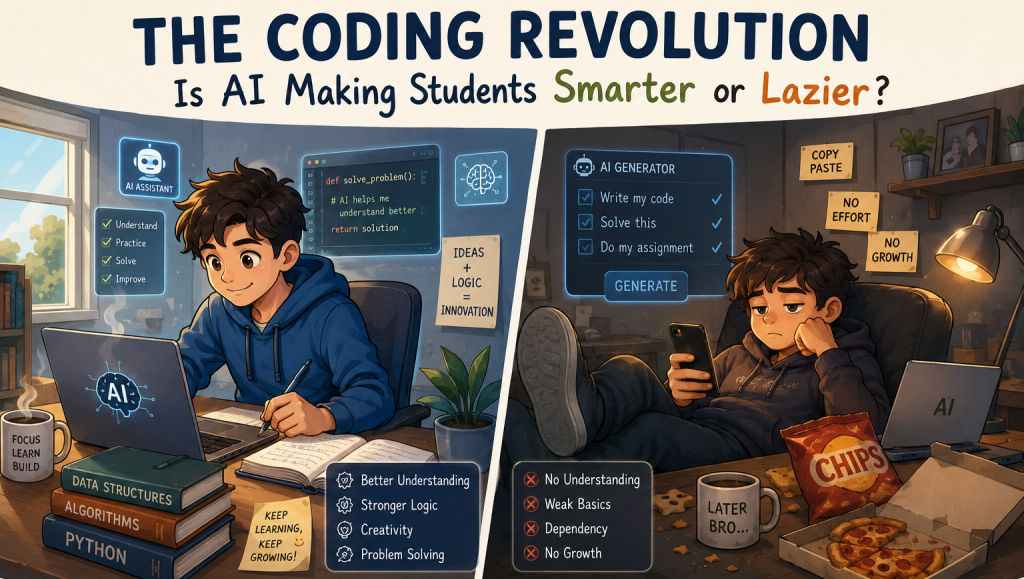
Imagine typing thousands of lines of computer code, pressing enter, and watching the whole screen crash because of one missing dot. For decades, learning computer science was a painful nightmare. Students spent sleepless nights crying over a single syntax error. But today? That nightmare is dead. Now, an eight-year-old child can tell an AI, “Build me a video game about a flying astronaut,” and it appears instantly. Why am I writing about this? AI in education is the hottest topic in the market right now. Everyone is talking about it, and everyone wants to know: Is AI creating tech geniuses, or is it making students completely lazy? Elementary School: Learning Without the Stress In primary schools, learning about computers used to be a bit boring. Kids just dragged colorful blocks around a screen to move a digital cat. Today, kids just talk to the AI like a friend. They ask for a feature, and the AI builds it instantly. The AI then explains the logic behind it. This allows little kids to focus entirely on creativity and big ideas instead of getting stuck on frustrating technical rules. High School: A 24/7 Coding Tutor High school is where students start typing real text languages like Python or Java. In the past, this is where most students got confused, lost confidence, and quit. Now, AI acts as a patient, always-available helper. When a teenager writes broken code, the AI does not just say “Error.” It looks at the mistake and gently explains, “Hey, you forgot a small part here. Don’t worry, here is how you fix it. “It keeps students excited instead of frustrated. Higher Education: Trading Typing for Thinking At the university level, the change is massive. In the old days, college students spent weeks writing basic, repetitive lines of code from scratch. But today, AI can write that basic code in two seconds. Because of this, professors are completely changing how they teach. Students are no longer graded on how fast they can type code. Instead, they are graded on how well they can check the AI’s work, find bugs, and connect giant software systems together. Why AI is an Amazing Tool? Super Fast Learning: Students do not get stuck for hours on a single mistake. They get instant feedback and keep moving forward. Personalized Help: The AI acts like a private tutor that perfectly matches the student’s speed. It gives easier hints to struggling students and harder challenges to advanced students. No More Busywork: AI handles the boring parts of coding, allowing students to focus on the big picture and build cooler projects faster. The Risks We Must Avoid The “Lazy Brain” Danger: If the AI does all the heavy lifting, students will stop thinking for themselves. If you never struggle with a hard problem, your brain muscles will never grow. AI Mistakes: AI tools sound very confident, but they can be completely wrong. If students blindly trust the AI without checking the facts, they will learn incorrect information. Massive Cheating: Teachers are heavily struggling with plagiarism. Since AI can write perfect assignments instantly, it is becoming very hard to know if a student actually understands the lesson. AI will not replace human programmers. But programmers who know how to use AI will replace the ones who don’t. The goal of computer science education today is no longer to teach humans to type like a machine, but to teach them how to lead the machine.